

BY TJ GUILE
This is a story, set in early eighteenth-century London high society. It tells of a wealthy young Catholic couple from fine families, who were engaged to be married, but fell out of love with each other due to an unfortunate incident over a lock of hair. This is the background to Alexander Pope’s poem in five cantos, The Rape of the Lock, which is inextricably linked to the Fermor family of Tusmore Park, Oxfordshire. The ‘rape of the lock’ to which the poem’s title refers, and the major event of the poem, is the seizing, by force (‘rape’ coming from the Latin ‘rapere’, to seize), of a lock of hair from a young lady named Belinda by her suitor, the dastardly Baron. Pope dedicated the second edition of The Rape of the Lock to Arabella Fermor daughter of Henry Fermor of Tusmore Park.
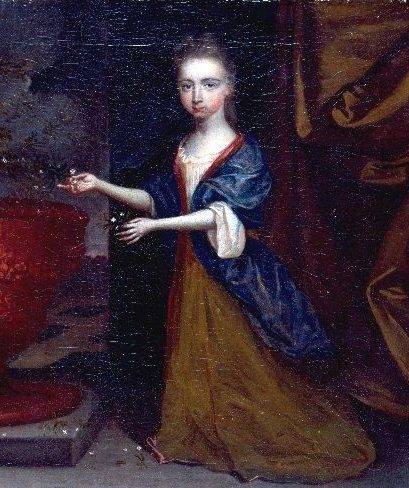
Photo Credit: Courtesy of Reading Museum
The work was inspired by the scandalous news that Robert, Seventh Lord Petre (1690–1713), had in 1711, publicly cut a ringlet from the head of Arabella Fermor (c.1689–1738) who he was courting, as a joke at a party. Before the marriage, painters and poets celebrated her charms and her beauty, she was said to be the belle of London society. In fact, she was known to the family as Belle. But the incident caused a rift between the two Catholic families. John Caryll, Petre’s guardian, asked Pope, also a Catholic, and known to the Fermor family, to write the poem to heal the rift and to ‘laugh them together again.’ In Pope’s verse, Belinda represents Arabella, while the Baron represents Lord Petre. He used the character Belinda to represent Arabella and introduced the idea of sylphs, or guardian spirits of young women, almost like the gods and goddesses of conventional epic poetry of the time.
Say what strange motive, Goddess! could compel
A well-bred lord t’ assault a gentle belle?
O say what stranger cause, yet unexplor’d,
Could make a gentle belle reject a lord?
In tasks so bold, can little men engage,
And in soft bosoms dwells such mighty rage? [1]
The first version, with just two cantos, was dashed off in a fortnight in 1711 and privately circulated. At first, Arabella did not mind the short poem but as time went on, society friends began to make fun of her. Pope urged Arabella to forget the incident and forgive Lord Petre.
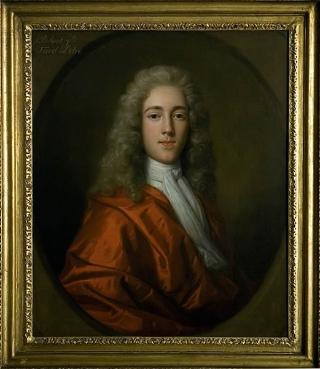
Photo Credit: Courtesy of Ingatstone Hall
The plan failed and Arabella broke off the engagement. Lord Petre subsequently married Catherine Walmsley, a fifteen-year-old wealthy Catholic heiress, in 1712, but died a year later of smallpox. Arabella appears to have felt humiliated and accepted an offer of marriage to live quietly in the country instead. In 1715 she married Francis Perkins, a man much older than herself, of Ufton Court, Ufton Nervet in Berkshire.
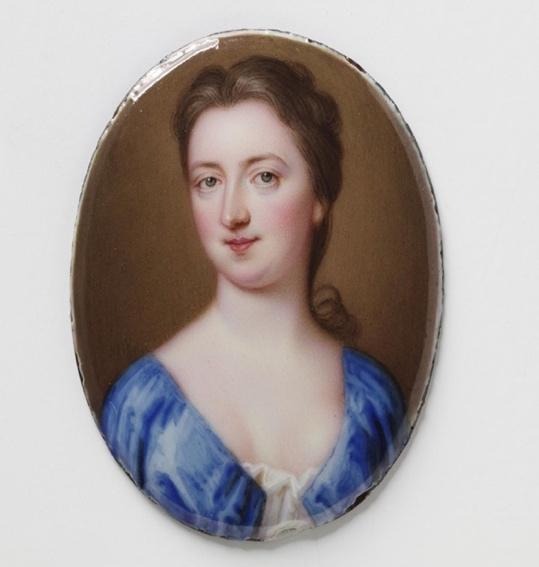
Photo Credit: Courtesy of V and A Museum
The poem was extended to five cantos in 1714 after the death of Lord Petre. It promised readers a secret glimpse of high society folly, revealing how a young baron stole a lock of a lady’s hair. In this mock-epic poem Pope teases Arabella Fermor that ‘the ancient poets are in one respect like many modern ladies: let an action be never so trivial in itself, they always make it appear of the utmost importance.’ In Canto five, Belinda, that is, Arabella, was seen to be very angry with the perpetrator of the act. [2]
“Restore the lock!” she cries; and all around
“Restore the lock!” the vaulted roofs rebound.
Pope continues later in Canto five with some advice for Arabella.
Then cease, bright nymph! to mourn thy ravish’d hair,
Which adds new glory to the shining sphere!
Not all the tresses that fair head can boast
Shall draw such envy as the lock you lost.
The poem is written as a mock epic using the grandiose style of ancient Greek and Roman epic poetry such as the kidnapping of Helen of Troy which was very fashionable at the time, to satirise the self-importance of the fashionable London elite. The purpose was to mock the foolishness and triviality of contemporary society, but also perhaps in the sense that it uses these domestic events to exaggerate the importance of this event. The 1714 extended edition of the poem sold around three thousand copies in a matter of a few days. Pope added to this second edition, the following dedicatory letter to Arabella to placate her anger at being seen as the butt of humour.
It will be in vain to deny that I have some regard for this piece, since I dedicate it to You. Yet you may bear me witness, it was intended only to divert a few young Ladies, who have good sense and good humour enough to laugh not only at their sex’s little unguarded follies, but at their own.
Pope added: “For the ancient Poets are in one respect like many modern Ladies: let an action be never so trivial in itself, they always make it appear of the utmost importance”. [3]
The moral of this story of Arabella Fermor and Lord Robert Petre, if any, is not to let small incidents or resentment cloud your judgement and spoil your future happiness.
Footnotes
[1] https://www.poetryfoundation.org/poems/44906/the-rape-of-the-lock-canto-1
[2] https://www.poetryfoundation.org/poems/44910/the-rape-of-the-lock-canto-5
[3] https://genius.com/Alexander-pope-the-rape-of-the-lock-dedication-annotated
Books
Guile, T J, Somerton, Tusmore and the Fermors, Cake and Cockhorse, Volume 24, Banbury Historical Society, Banbury Litho, Banbury, 2022.
Jessup, M., A History of Oxfordshire, Philimore, Chichester, 1975.
Rayner-Smith, C., Hardwick-Cum-Tusmore, Parchment Bicester, 1999.
Wickham-Legg, L. G. (Ed), Tusmore Papers, Oxfordshire Records Society, Oxford, 1939
Websites
https://www.wikiwand.com/en/Somerton,_Oxfordshire#Parish_church
http://www.lostheritage.org.uk/houses/lh_oxfordshire_tusmorepark.html
https://www.parksandgardens.org/places/tusmore-house
https://www.thedicamillo.com/house/tusmore-house-tusmore-park/
https://www.bl.uk/works/the-rape-of-the-lock
https://vauxhallhistory.org/william-juxon/
https://www.poetryfoundation.org/poems/44910/the-rape-of-the-lock-canto-5

