
BY JOHN TUTTLE
There is something inseparable from our human nature that gives rise to sharing stories. We tell stories about people or things we think are important. If we go to the effort of telling a story, we obviously think the content is worthwhile. And, in telling a story, the storyteller has the opportunity to sway the inclinations of the listener to align with their own value system. Paul Krause—a teacher, essayist, and short story writer—thinks stories themselves are important.
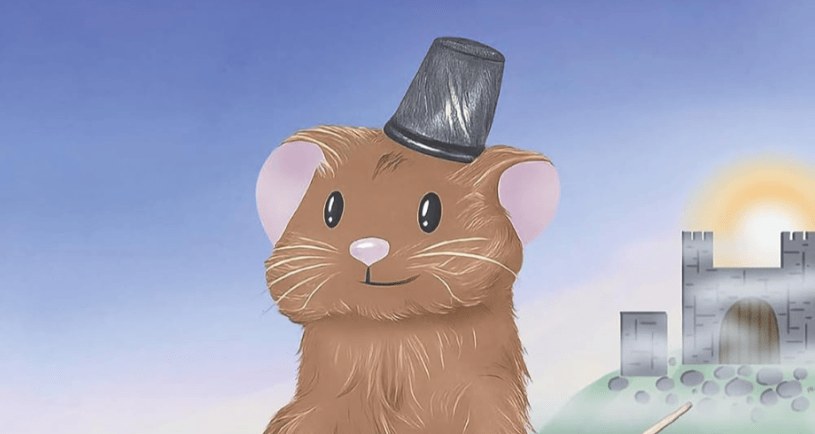
In the eyes and ears and imaginings of the wild, free folk of the Great Forest and of “the whole wide world of Gardenwall,” Sir Biscuit Butterworth is a tiny hamster of towering importance. Both hero and friend, his adventures see him in a successful effort—the outcome initially unbeknownst to himself—of continually expanding his circle of friendship. In fact, the plot of many of the tales contained in Krause’s Sir Biscuit Butterworth and Other Short Stories, Poems, and Fables follows a simple recipe: Sir Biscuit and his comrades set out to vanquish a perceived foe only to find out that their foe is neither a true nemesis, nor as ferocious as the stories would have our heroes believe. Along the way, they experience lighthearted fun and intimidating fear and learn that stereotypes often don’t do justice to the real people they are associated with.
The greatest theme set down in Krause’s anthropomorphic tales of rodents, cats, and foxes—of swashbuckling quests and damsels in distress—is that of genuine friendship. It is that same theme that links these tales to some of the later stories found in this collection, like “Sunny the Swan” and “What Tucker Saw,” which illustrate the bittersweet nature of many human and pet relationships. If a common recipe is shared among the plots of several of these stories, it must also be noted that the lessons which Krause teaches are also worth imbibing more than once, as are all of life’s most important lessons.
When the adult reader begins reading the exploits of Sir Biscuit Butterworth, he may quickly pick up on the influence J.R.R. Tolkien made on the telling of these tales of a hamster and his mousy companions. For example, Timmy Two Times possesses a three-fold similarity with the creature Gollum from Tolkien’s The Lord of the Rings: 1) Timmy is initially antagonistic. 2) As with Smeagol being renamed “Gollum” for the guttural sounds he makes, Timmy’s moniker “Two Times” describes his unique speech pattern in which he is apt to repeat some of his words. 3) Timmy challenges Sir Biscuit to a game of riddles, just as Gollum did with Bilbo in the children’s novel The Hobbit.
Middle-earth isn’t the only world which left its mark on Sir Biscuit’s. In a culture thoroughly entertained by Brian Jacques’ Redwall series and the more recent phenomenon that is Erin Hunter’s Warriors, Sir Biscuit Butterworth and his companions may well find a warm and willing audience. The primordial game of cat and mouse, which humanity has been witness to long before Stuart Little or Mouse on the Motorcycle, takes a new twist in Krause’s stories.
In his descriptions and character names, Krause displays an affinity for alliteration. We can take stock of the cast of characters to get a taste of this: Biscuit Butterworth, Timmy Two Times, Phineus the Furry Furball, Wily Whiskers, Tiny Theo, Count Conrad the Cat, and others.
Despite what may be whimsical or cheesy about the characters and situations in the world of Gardenwall, the little animals are alive with human faculties, as must be the case in any anthropological tale. They display charity and courage and a gift for telling stories. But they are also religious beings. In this regard, the characters display an intriguing hodgepodge of beliefs, inhabiting a world in which mice cross themselves but also have developed a cult in honor of past heroes, such as Saint Phineus the Furry Furball.
However, such overt religiosity is not found consistently through the tales of Sir Biscuit and his growing crew of co-adventurers, though there are other moral elements that surface in explicit ways. The value and beauty of friendship, noted above, is one of these. Another such moral, if it can so be called, is the power of stories—that heroes and loved ones can “live on” in memory through the passing on of stories. This is a cornerstone concept of the last two stories in the collection, cited above, which focus on a swan and a dog and the relationship each has with their human companions. It is also front and center in “The Incredible Story of Geronimo the Mighty Mouse,” which is the most charming and endearing of the tales contained in this little book. Perhaps this is because, though fantastic, it all feels so real—the love of family, the fulfillment of one’s dreams, the encouragement of stories, the viciousness of a real villain who must be opposed, the bravery of a damsel who is just as cunning and courageous as her hero. (Plus, the damsel in question is one of the few princesses who is the genuine article, not merely an edible staple doomed to a grizzly fate. To understand that, you simply must read the book!)
But to return to the notion of overt moralizing: Krause utilizes this with effect in his own short stories, just as it was in many of Aesop’s fables, though it was not the preferred modus operandi of Tolkien, whose fiction brims with more latent, implicit meaning, otherwise influenced the author of Sir Biscuit Butterworth. Other up-and-coming Christian creative writers, such as educator Ellen Jewett, have likewise adopted a more explicit style that does not shy away from clearly conveying the lessons they are trying to impart within a self-contained story. An example of this comes near the close of Krause’s heart-tugging “Sunny the Swan,” in which the beautiful bird tells the following to his lifelong friend, Mary:
Swan’s don’t live forever, but if you keep me in your memories, I will live on even after I die. And if you tell stories about me, I will live on even longer in the sacred place of human memories.
If many of the foregoing stories are whimsical, here’s one that looks past the ridiculous and stares mortality in the eye. The fondness of memories can be felt in many cultures the world over, but the idea of memory as something sacred stretches far back in time along Judeo-Christian roots. In Judaism, the Festival of Booths involves constructing temporary “booths” to live in, commemorating and re-enacting the nomadic lifestyle of the Israelites during their time of wandering through the wilderness. The feast of Passover likewise commemorates a major moment in salvation history and, even in the time of Jesus, included recalling the story of the Exodus through reading the Scriptures, keeping the memory of God’s deeds alive. The liturgies of Christendom similarly tap into the Word of God, which, for believers, is not a bygone message but living and effective. And the Eucharistic rite, enacted in obedience to Jesus’ command at the Last Supper to do so in remembrance of him, taps in directly to the timeless Sacrifice of Christ.
Memory is something sacred for Krause too. And if stories serve as a vehicle for memories, then they are, in turn, sacralized. There is perhaps something bordering on that Judeo-Christian reverence for the past and its ongoing, living tradition in the words of Krause’s afterward, “By reading and listening to stories we enter a truer world than the world outside which stands before our eyes.” Perhaps recognizing that truth just requires seeing with the eyes of faith.
Sir Biscuit Butterworth and Other Short Stories, Poems, and Fables (2026) by Paul Krause is available from Wipf and Stock Publishers.
 Fellowship & Fairydust