
BY R.C. MULHARE
“Though he shall escape the waters’ flood, yet shall he find a thousand troubles in his country when he arrives.” – Cassandra, The Trojan Women, Euripides
April 19th, 1775
Charity Meecham shook herself awake, sitting up slightly from her pillow to clear her head of the cobwebs of nightmares from late in the night. Early daylight showed under the edge of the sacking that covered the window beside the head of the bed, which she shared with her sister Felicity.
Her sister, clearly having risen before Clarity had awakened, crept under the covers and nestled against her. Clarity shifted away from Felicity.
“Did the nightmare run roughshod over you?” Felicity asked.
“Yes, though I tried my best to drive it away,” Clarity replied.
“Did you drink your physick last night?” To help her sleep deeper and keep the eye within closed, Clarity often drank an herbal elixir concocted by a neighbor conjure-woman and friend of her departed mother Elise.
“A dram of it before I retired.” She winced slightly recollecting of its sour taste. Even after five years since the eye within had first opened shortly after she reached her majority, she still could barely stomach the taste of the physick.
“And it had no effect? Mémère Violette must have shirked on some of the ingredients.”
“No, the fault lies in my wits.”
Something clattered at the window, as if someone had tossed a handful of pebbles. Clarity, lying closer to the window, rose to draw back the curtains and lift the sacking.
Gabriel Shortsleeves, the ‘prentice to Malcolm Bowen, the blacksmith, stood below in the soft morning light, grinning up at them. Clarity unlatched the casement and swung it open. “Miss Clarity, Miss Felicity, pack up your most prized possessions. Dr. Prescott has sounded the alarm: The Redcoats are on the march from Lexington.” His tone tried to sound serious and imperative, but his youthful delight broke through in a slight smile.
An image from her nightmares flitted into her Clarity’s mind: A British soldier’s musket ball piercing Gabriel’s neck, then she saw Gabriel lying in the shadow of a maple tree, his mother and two other women discovering him. She drew in a breath, releasing the image as she breathed out. “They come so soon?”
“They engaged the men of Lexington on the green, now they march on Concord. Our men are readying their powder and their shot. It is for the best if you get clear of this place.”
Felicity joined them at the window. “What news?”
“We must be away: the Crown’s troops march on Concord after they engaged in Lexington,” Clarity replied.
“I have laying hens sitting on their nests and recently hatched chickens,” Felicity replied.
“Can you bring them along?” Gabriel called up.
Felicity tilted her head, smirking down at him. “How am I to carry a whole coop full of hens, even in the cage that I use for market day?”
He shrugged. “Then take the best of the lot. If our militia men are to be ready at a minute’s notice, so should those who must evacuate.”
“And where are we to go?” Felicity asked.
Gabriel glanced down to the road. “Marlowe has offered the use of his barn as shelter.”
“We have wasted enough time jawing when we could be collecting our chattels and fleeing,” Clarity said and went to the clothes press and fetching one of her daily stuff gowns, pulled it over her shift. She shoved her feet into her leather mules. She hastened to the kitchen, grabbing the last of the dried pears and a half wheel of cheese, tying them into a cloth. She went to her father’s study, finding the commonplace books in which they had jotted her more pressing visions and the best of her father’s grimoires and books of philosophy and theology. She slipped them into his spare leather satchel, the worn one he had left behind after he had packed his better one and left for Boston.
Bringing the bundles back to her room, she pulled on her stockings and shoes. She found the family money box hidden on an upper shelf of the clothes press, tucking it into the bottom of the leather satchel. She went to her father’s bedroom, the sanctum he had forbidden her to enter til the day her talent had first manifested. She found the small tome he kept on his dresser and her mother’s jewel box, adding them to the leather satchel. She collected a bundle of clothing which Felicity had left on the floor of their room.
She hastened out into the chilly April morning, going to the chicken yard. Felicity approached her, pushing the farmyard handcart, containing the light cage she used for market day, in which several young hens now clucked irritably.
Clarity tucked the bundles into the cart. “Have you anything else to bring?”
“Not that I can think of. Can you take the handcart while I fetch Chance and her calf?”
“Certainly.” Clarity obliged. Through the trees, barely showing leaves this early in the season, from far in the distance, she could hear the piping of fifes and the rattle of drums. “Do you hear that?”
Felicity looked in the direction of the sound. “I was about to ask you if you heard that as well. Have the eyes within opened in this moment?”
Clarity shook her head. “For now, no. The eyes within are closed.”
Felicity nodded, then went to the barn. She returned, leading their milk cow, the calf trotting behind them. They trundled down the footpath to the post road. The Widow Tweed from the next farm approached with her young sons, Jonathan the elder, not old enough for the militia, trundling their handcart, Jason the younger running ahead, miming that he played the flute and whistling “The British Grenadiers” along with the fifes in the distance. Clarity pulled her eyes away, trying to avoid the images that threatened to crowd into her mind, of Jason by turn walking down the aisle with his young bride, the Campbells’ youngest daughter, or falling from a barn roof as a stripling youth.
Felicity fell in step with the Widow Tweed, chatting with her, one woman missing her father away in Boston advising the Adamses, the other who had lost her husband in a hunter’s accident.
“I hope these Continentals are happy with all this bother,” Widow Tweed muttered. “They shore don’t have to shift chattels and children because o’ boys fightin’ over tea and taxes. Don’t they know how their little spats tax the farm folk?”
“Some do, one would hope. But others may have too much on their mind, dealing with the friction between the Crown and the Colonial government,” Felicity said. “They have so much to bear that our discomfort falls to the bottom of the list of their concerns.”
“What even are they fightin’ over?” Widow Tweed grumbled.
At that question, however reasonable, the eyes within Clarity’s mind opened. She tried to close them by refocusing her attention on the world about her: the spring birds chirping in the trees, the scent of recently turned ground, the baaing of sheep in a pasture, even looking to the dusty track beneath their feet, but to no avail.
Clarity stopped in her tracks, lowering the handcart onto its legs, the edges of her vision turning gray as the world around her started to darken. “Felicity, can you take the cart?” she begged. She heard Felicity call to Jonathan, asking him to take Chance’s halter. She felt Felicity taking the handles of the handcart, gently guiding her to hold the side of the cart. She felt the load shift. “I am ready now,” Clarity murmured.
She felt the cart move as Felicity moved on. She managed to keep her footing as they moved on. Even as Widow Tweed continued to murmur and Jason continued to whistle, the sounds that accompanied the images playing in the camera obscura of Clarity’s mind drowned them out…
…A cloud of gunpowder obscured the North Bridge. Men she had sold cheese and candles to and sat near in chapel with muskets and fowling pieces leveled at ranks of Redcoats, exchanging volleys of shots. A musket ball went wide, felling Fredrick Campbell, the butcher’s nephew, who had lingered at her and her sister’s market stall, chatting with her longer than he needed to.
More Colonial soldiers, gradually appearing in garb that matched, fighting the Redcoats yet still falling in battle on different battlefields in places unfamiliar to her or coming away from them wounded.
A group of well-dressed men, seemingly well-educated, arguing over the composition of a document, wrangling like hagglers in a market over what they should include or exclude.
A general in dark blue on a white horse, leading an army under a flag like a Union Jack only with a blue field, accepting the surrender of a red-coated officer
A mansion burning in a city that seemed to serve as a capital of this newly emerged country.
The descendants of the Colonials moved further west across the land, past a mountain range. She saw groups and trains of people and families, some on foot and some in wagons, into a forested land. She saw their descendants moving further west, past a wide river, across a grassy land. In time, they would raise settlements as far as the shores of the ocean on the other side, a place with stands of great evergreens and drier lands that made her think of engravings and paintings she had seen of Italia,
But she also saw the sufferings of those who had dwelt there before, hunting and fishing for many generations. She watched a caravan of these folk leaving their native lands, many of them exhausted and starving, men in uniform watching over them. At one point, she beheld a Native mother fallen in death by the path-side, her child beside her crying out.
The ingenuity of the descendants aided in the expansion of their nation. Boats that moved without wind or visible paddles traveled on canals dug between rivers and great lakes. Webs of iron grating roads stretched across the land, carrying lines of enclosed carriages and wagons pulled by engines powered by fire and steam.
Though many claimed freedom and equity in this growing nation, she beheld things that undercut the veracity of this. She beheld great fields of cotton and other crops tended by dark-skinned people toiling for long hours, unable to leave or move at their choosing to a kinder employer. She watched an older man, too tired to work one minute longer, beaten by a lighter-skinned man with a whip till the worker bled. She saw a group of people, led by a small but sturdy dark-skinned woman in the dead of night, slipping through a forest to a house with an open door and kind folks who welcomed them, offering them shelter on their next stop toward “the North.”
A tall man with a distinctive face with wide cheekbones and solemn eyes, standing at the back of a crowd at a slave auction, a look of horror and sorrow gathering his face.
That same tall man, now older and clad in a suit with a long jacket and long trousers, debating a shorter man in a finer-cut suit on a platform draped in bunting with stripes of red, white, and blue, before a crowd.
Another battlefield, men in blue uniforms beneath a flag with white stars on a blue field and red and white stripes fighting men in gray uniforms under a flag with a blue St Andrew’s Cross on a red field, the ground beneath their feet soaked with blood. She sensed a kinship between some of the soldiers, as if members of the same family fought against each other.
The tall man on another platform set on that battlefield, now a presider of some kind, delivering an impassioned speech to a gathering who responded with stunned silence.
Yet again she saw the tall man, sitting at a private box at gathering place during a performance of some sort. The tall man joked with a finely-dressed woman, clearly his wife. A handsome man armed with a pistol slunk up behind the tall man, firing at the back of his head. The tall man slumped against his wife, the assassin leaping over the parapet of the box to the platform below.
As the country rebuilt itself after this war, more ingenious people continued to craft many things meant to better people’s lives: lights that ignited with the flip of a lever or turn of a knob, which depended on a crackling energy which traveled through webs of long cables, rather than tallow or whale oil. Carriages which moved without horses or oxen to draw them, powered instead by fire sustained by a substance derived from a black oil pumped from the ground. Rivalries rose between business partners and wars broke out over countries who could produce the substance and the countries who desired it. Fortunes would accumulate, not evenly distributed between the “captains of industry” who claimed them and the workers who served them.
The land, which hailed itself “Columbia” or “America,” would soon stand on its own as an equal among other, much elder nations. Rather than fighting against Britain, the descendants of the Colonials would fight alongside the descendants of the Redcoats on a battlefield across the sea, facing a nation armed with new and terrible engines of war: machines like small metal forts with cannons atop them and unseen compounds that burned the lungs and flesh of the unexposed.
Fortunes would continue to rise and fail, enriching the nation, yet the esteem brought by wealth caused many to ignore their duty to the less fortunate, often giving way to distracting pleasure-seeking, dancing faster and faster to wilder music with heavier beats.
The dancing could not last. She saw fortunes failing, even average folk devastated, the poor growing destitute, living in hovels collected under the name “Hoovervilles.”
Blame flew among people as they had in Salem Village nearly a hundred years before. One nation, broken by war and the humiliation of an uneven treaty, desperately heeded the ranting speeches of a small man and the cabal that surrounded him, laying the fault on one group after another, resulting in their imprisonment. Lines of carriages drew these scapegoats, yellow stars or red and rose triangles on their coats, to a place with a giant smoking chimney surrounded by coils of fences woven of sharp wire.
A harbor full of large metal ships without sails, peculiar things like giant metal birds diving at them from the sky, firing volleys of shits. Plumes of fire and columns of black smoke boiled up from them. Sailors darted about the decks, crying out, some leaping from the deck into the water, itself on fire.
A dry place with scrubby plants suited to a dry land, men hunkering in structures braced with earthen walls behind berms of soil and rock, a tall slim man with intense blue eyes behind darkened glasses and an equally tall but huskier man in a tan uniform seeming to lead the crew. A flash brighter than the sun boiled up from the dry land, unfurling into a cloud of fire and smoke that unfurled into the shape of a mushroom.
A silver shape like a giant bird with unflapping wings soared over an unfamiliar city with exotic-looking buildings. A dark speck dropped from under the bird-like engine, which turned aside flying away quickly. The speck blossomed into that dark mushroom shaped cloud, the city below transforming, buildings seeming to vaporize as a ring of fire boiled through the streets. Cries of the suffering tore through the air, as the inhabitants tried to flee the blast, many vaporized by the blast leaving only shadows on the pavement beneath them.
More fiery blasts boiled up in seeming tests, some in the desert she had seen before, with people watching from the safety of a tall building at distance, watching as if they sat at a musicale. Others took place in a colder place, under the guidance of people speaking a different, harsher language.
More young men in green uniforms designed to blend into the jungle in which they fought, fighting against implacable enemies who would send women and even children as warriors. Villages set ablaze with something like Greek fire that clung to everything. Men returning to the land of the stars and stripes, their souls and bodies damaged, many retreating into chemical comforts to heal what would not heal. Governors and councilors lauding the war as a means to protect the West from something called a “Red Threat,” while young people, often scholars, unkempt in their garb and their grooming but passionate and sincere in their opposition to this war, gathered in the streets while bearing placards written with slogans that decried the state of their world.
A dark-skinned man, the descendant of enslaved people, speaking on the steps of a temple-like monument, housing the statue of the tall, bearded presider, his voice echoing over a gathering of thousands, their faces every shade of the human rainbow, speaking of a dream of peace and brotherhood for all, his words ringing across a square pond that reflected the sky above and an avenue of classical buildings.
A handsome man, another presider, it appeared, riding in an open-topped horseless carriage, his wife at his side through a great city, a cheering crowd greeting him. A shot cracked and the presider jerked, bleeding from his head.
The images came faster and faster. The clever and inventive created machines that moved the world faster and faster: engines that helped craftsmen manufacture goods, allowing more people to have more things quickly. While this enriched the lives of many, others still floundered, most through dire circumstances. Envy at the haves wrankled among the have-nots increased as the gulf widened between the classes. Countries around the world supported the former Colonies, while others detracted them, particularly for their flawed prosperity. She could not help but foster some understanding for the sentiments of the latter, for seeing through the former Colonies’ masks. She saw two sky-scrapingly tall buildings collapsing after two silver sky-chariots struck them. She saw young men and women in uniforms meant to blend in with the sand and scrub plants in the dry place they fought in for reasons she could not untangle.
She saw people in the former Colonies turning against each other, brother against brother, family against family, neighbor against neighbor, not limited to their immediate circle but people from across the country, trading slights projected onto small windows which people carried in their pockets. While she had seen heated disagreements among neighbors and family, this certainly did not include total strangers from across the country, using a web of unseen electronic threads, which for all its rapidity of sending message and sharing information and kind words, also allowed people to all drop masks of politeness.
The images grew darker, people turning against each other across even less-defined lines, tearing the former Colonies apart, leaving it helpless to attacks from without. She found herself staring at a woman huddled in the ruins of a house, skin burned, dark brown hair falling from her scalp, eyes hollow with sorrow, her hands in her lap, cradling the body of a tiny bird with blue and gold feathers, its song silenced….
Just as suddenly as the eyes within had overtaken her sight, they closed and released her, bringing her sight back to the visible world of the present day, her present day. She shook herself, choking back a howl of horror.
“Are you well now?” Felicity asked.
Clarity shook her head, feeling herself waver on her feet, her head starting to sing. “No, no, I have seen too much. I have seen the future. I have seen too much of it. I have seen the track which the Colonists shall take and I cannot see it come to pass.”
Felicity regarded her with a deep frown of concern. “What do you mean? What have you seen?”
“Many wondrous things, but even more worse things,” Clarity said.
“And what will you do?”
“If I can stop the shots from being fired, I will do what I must,” Clarity said. She released the side of the handcart. Tucking up her skirts, she hastened down the road, back the way they had traveled, toward the fifes and drums.
She caught up with a column of Colonials, farmers she had traded with at market day, craftsmen she had sold her herbs to, all armed with muskets and fowling pieces. “Stop! Hold back! This can be worked through another way! Some other way! Is this moment worth our future?”
A few men at the rear of the column glanced toward her. One farmer laughed, shaking his head. Malcolm Bowen, the blacksmith, called out to her with concern in his eyes and tone.” Go on to Marlowe’s barn and take shelter. This is no place for you.” A farmer she did not recognize, perhaps from another town, murmured a question to his neighbor, Therioux, the Frenchman from Nova Scotia, who replied with a chuckle, tapping the side of his head with his free hand, as if calling her mad.
Clarity trailed the militia men, calling out to them, continuing to beg them to halt, even while they continued onto the track leading to the North Bridge, the men at best ignoring her, at worst calling back rough jests or telling her to go home. Except for Fredrick Campbell, who marched on the other side of Therioux, who glanced aside at her, his eyes worried. As if to taunt her, the eyes within showed Fredrick, leaned against a rock, bleeding from his forehead, a Redcoat aiming at him from nearby.
Therioux nudged him. “If she can see what will become, she can see the outcome of this battle, yes?”
“You can ask her. She can speak for herself: she has been speaking so for the past half a mile,” Fredrick said.
“Ehh, girl! What did you see that has you so shaken?” Therioux called to her.
“I saw what this battle will bring to this land,” Clarity called back. “This is but the first of many battles in the name of this country. Some of them, I can see the cause clearly, others I cannot see so well. It will end badly. We shall see success, but too much blood will be shed and the track you tread will end in wrack and ruin for our descendants.”
“At the least, we will hold back this band of lobster-backs, non?” Therioux called back, laughing.
“There will be more than the British whom we and our descendants will fight. There will be times when brother will turn against brother. Not all of them shall be on these shores.”
“So will we have our colonies much as Britain does?” Therioux asked with a grin, but Fredrick threw him a hard look.
“I could not say, but America shall stand on its own among other kingdoms and countries,” she called back.
The bridge came into view around a bend in the path. The fifes and drums of the British grew louder as their lines approached the bridge. The Colonials fell into rough lines. The British marched closer, spanning the bridge, an officer on a brown horse riding near the head of the column. The leader of the Colonials called out to them. The British officer shouted back, ordering the Colonials to disperse. More cries and shouts rose. The Colonials leveled their firing pieces as the British leveled theirs.
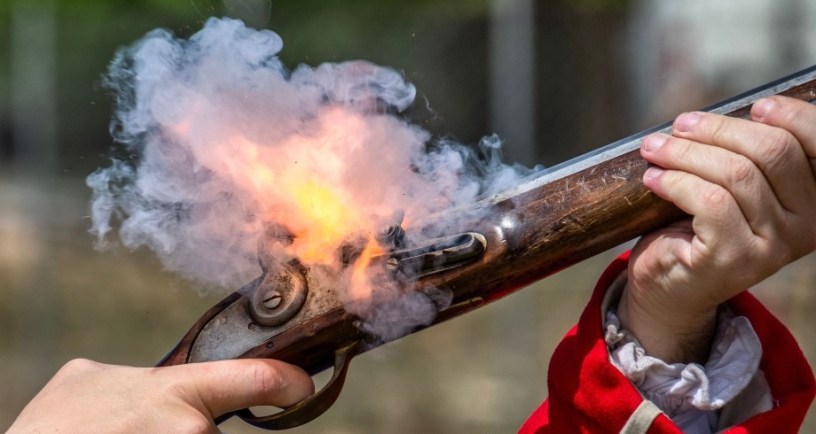
Fredrick Campbell had leveled his flintlock, his thumb on the lever. The shouts back and forth grew more intense. Seeing his attention diverted, Clarity lunged at Fredrick, grabbing his arms and trying to wrest the rifle from him. In so doing, he kept his grip, but the muzzle of the rifle flew up as a shot rang out. Clarity’s ears rang, but she still heard shouting and more shots firing. A musket ball whizzed past her head. She managed to pull Fredrick down. He rolled over her, trying to wrest the flintlock from her grasp, but she rolled with him into last year’s dried bracken by the side of the path.
Fredrick released the piece, breaking their connection, propping himself on his elbows. “Clarity, what have you done?”
She lowered the rifle to the ground, releasing her grip and propping herself on her hands, facing him. “I sought only to protect you from a possible death. I sought to stop the battle and protect other lives.”
He looked past her toward the skirmish. More shots rang out. A Redcoat fell, blood dyeing his coat a deeper shade of red as he staggered away from the fray. At length, he fell close to them, first to his knees, then sinking onto his side, his hazel eyes glazing over.
Fredrick held her gaze with his. “You caused the thing you sought to halt.”
“This is the curse of the eyes within. I am cursed betimes to stand in Cassandra’s place, to be heard but not heeded, like the seeress of Troy. I sought to succeed where she did not, and spare my country.”
“It would appear that you failed.”
She kept her gaze focused on his face, fighting the eye within as it threatened to reopen. “Or that fate succeeded in the best and worst way.”

