
BY AVELLINA BALESTRI
Tell us a little bit about yourself and your background.
I am a proud New Jerseyan, born and raised. I will forever be on a mission to proclaim New Jersey’s merits to the world. I was also born and raised a Catholic Christian and began taking my faith more seriously after Confirmation. I worked for an academic publisher, three libraries, and a Catholic parish before taking time away to be a full-time mom to two boys.
What first inspired you to start writing?
My very first inspirations were the stories that my dad read aloud to me from infancy. At about three years old, I began dictating my own stories to him. As I grew up, the novels I read in elementary school prompted me to try my hand at longer-form fiction and poetry.
How did you first become interested in history, and what are your favorite time periods?
The first time period I was actively interested in was the post-Civil War American West. This was a result of watching the TV series Dr. Quinn: Medicine Woman in tenth grade. I became obsessed with frontier towns, gunslingers, the American Indian Wars of the 1860s and 70s, early female physicians—basically any topic that related to the show.
After that, any time I had a personal connection to a time period, I would become interested in it. A friend once detailed how her family almost moved back to their native Germany in 1939, but was barred from entering the country. After hearing this, my mind began formulating a novel about a family separated during WWII.
Most recently, when I moved to the greater Morristown, NJ area four years ago, I visited some Revolutionary War historic sites. This sparked my interest in the American Revolution. I was then inspired to research my own family history. My cousin discovered that we have some ancestors who fought in the American Revolution and I was able to join the Daughters of the American Revolution chapter in Morristown. I think I’ll be interested in this time period for the rest of my life.
What started you on the journey of historical fiction writing in particular?
Over ten years ago, I started writing historical fanfiction for Dr. Quinn Medicine Woman but never attempted an historical novel. Being able to walk the same streets and visit the same homes as the people of Morristown in 1776 greatly inspired me to try and complete a full-length historical novel to honor the town and its people. I wanted to honor people, especially women, and Catholics, whose names briefly appear in the history books, and try to imagine their lives when the war came to town.
What are your favorite and least favorite parts of working within the historical fiction genre?
My favorite part is the vast collection of material to draw upon. I love my county library and Internet Archive. However, the most difficult part is sorting through all this information and deciding what historical truths might be helpful for telling the story.
How have you chosen which historical characters to feature in your books, and what made their stories resonate with you?
I mostly chose historical figures who were Morristown natives or who truly did pass through Morristown, NJ in their travels. Many of the historical figures I chose were simply names on a list of residents (such as schoolteacher Dorothea Cooper and Army wife Hannah Allibe) who I wanted to help breathe life into for readers. I also couldn’t resist choosing more famous Revolutionary war figures that readers might recognize. Finally, I chose an inspiring real-life Catholic priest who truly traveled from Philadelphia to New York on missions during the American Revolution because I felt the Catholic experience during the American Revolution was lacking in fiction.
What is your process in terms of research and bringing historical characters to life?
I try to read primary sources written by or written about each historical figure if they are available. However, at the end of the day, I utilize creative license to help these characters’ actions and conversations integrate with the fictional characters in an exciting way.
What is your method to integrate fictional characters and situations into the historical setting?
It’s different for each historical figure. Some are more central plot (such as Washington’s spymaster Benjamin Tallmadge), while some remain supporting characters with a minimal role. I try to portray and historical figures in a neutral way and give the fictional characters more distinct flaws or negative attributes. Of course historical figures had virtues and vices like the rest of us, but I usually don’t know what they were, so I do my best to remain neutral.
If you had the chance to convey a message to your favorite historical characters, what would it be?
I would ask everyone on both sides of the American Revolution: please don’t look down upon me for using your stories for entertainment. I know that they were likely much different than how I portray them, but know that I seek to honor you and your fight for your beliefs. To the residents of Morristown whom the history books don’t remember: I remember your names and hope that my readers will realize the sacrifices you made during the war.
What do you find more enjoyable/difficult: First drafts or editing/rewriting?
I find first drafts more enjoyable because I visualize scenes in my head long before I write them. When my pen catches up to my brain, it’s so much fun to bring long-anticipated scenes to life. I also enjoy revising because often my first try at a scene is not very polished, so it’s fun to clean up these scenes to be more exciting and clear for the reader.
How have you gone about publicizing yourself and your works?
I don’t love putting myself out there on display, but I now realize that being an author demands it. Thankfully, my local libraries have supported me a lot by circulating my books and allowing me to present a few author talks. I have also signed up for various book fairs in my area. I am a part of four book clubs, so I try to share about my books there. use Instagram, Facebook, and Goodreads to publicize my latest works and events. Finally, can’t beat word of mouth advertising, as many of my family and friends have been very supportive and have wanted to read and share my books.
What are some of the main themes/morals you would like readers to take away from your works?
I would like to draw readers’ attention to the demands and sacrifices of war not only on the battlefield, but in the lives of ordinary people. In my books, I try to portray how family relationships, romantic relationships, and friendships are affected during wartime.
Today, whether or not our country is currently at war, we each fight our own daily battles of the mind and heart. I hope that my historical fiction books will help convey the perseverance of the human spirit across all generations.
What is some advice you would give aspiring authors, especially those focusing on the historical fiction genre?
I would recommend reading real stories of people living through the time period you’re writing about. You might be amazed at what you have in common with people who lived long ago, or what you find fascinating about their lives that you may want to include in your stories. Also, visit as many historical sites as you can!
Plug your socials, published works, and current projects!
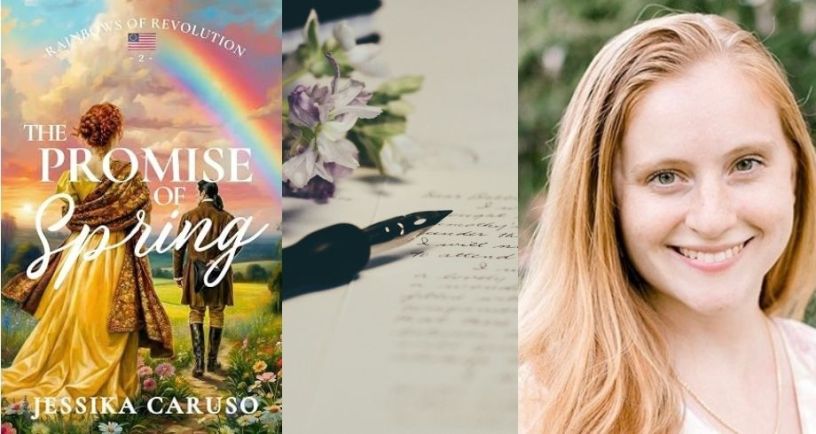
The first two books in my historical fiction series—Rainbows of Revolution—are now available on Amazon. Connect with me on Instagram at @MyHistoryJournal, Substack at @CatholicSafari, and Goodreads at Jessika Caruso. Thank you so much!

