
BY ALASTAIR JOHN REDMAN
Forget Outlander fiction.
The romanticised narrative of the mid-eighteenth-century Scottish Highlander as a natural, freedom-loving rebel against British authority crumbles under historical scrutiny.
The real Highlanders who emigrated to America right after the Jacobite rebellions did not fight for American independence; they fought bitterly and fiercely against it.
To understand this paradox, one must look at the devastating aftermath of the Battle of Culloden in 1746.
Following the defeat of Bonnie Prince Charlie’s Stuart uprising, the British Crown systematically dismantled the Gaelic clan system.
Tartan was banned, weapons were confiscated, and heritable jurisdictions were abolished. Facing poverty and displacement, thousands of Gaelic-speaking Highlanders crossed the Atlantic.
By the 1770s, a vast enclave of these immigrants had settled in the Cape Fear River valley of North Carolina.
When the American Revolutionary War erupted in 1775, one might have expected these victims of British pacification to enthusiastically side with the Patriot rebels.
Instead, the vast majority took up arms for King George III—the very crown that had crushed their homeland a generation earlier.
The reasons for this unexpected allegiance were pragmatic, deeply cultural, and legally binding. First, to secure land grants in the colonies, Highland immigrants were required to take a formal oath of allegiance to the British monarch. In Highland culture, breaking a sworn oath was a profound moral and spiritual transgression. Having seen the catastrophic consequences of rebellion in 1745, they had no desire to risk their families on another treasonous gamble.
Second, the Crown had granted them land and a chance at rebirth, whereas the local Anglo-American Patriot elites were often the very landlords and merchants who exploited or looked down upon the Gaelic-speaking newcomers. Finally, there was the powerful influence of Flora MacDonald, the legendary Jacobite heroine who had famously helped Bonnie Prince Charlie escape to France.
After emigrating to North Carolina in 1774, she used her immense cultural prestige to rally the clansmen to fight for the King, whilst her husband accepted a commission in the British Army’s Royal Highland Emigrants regiment.
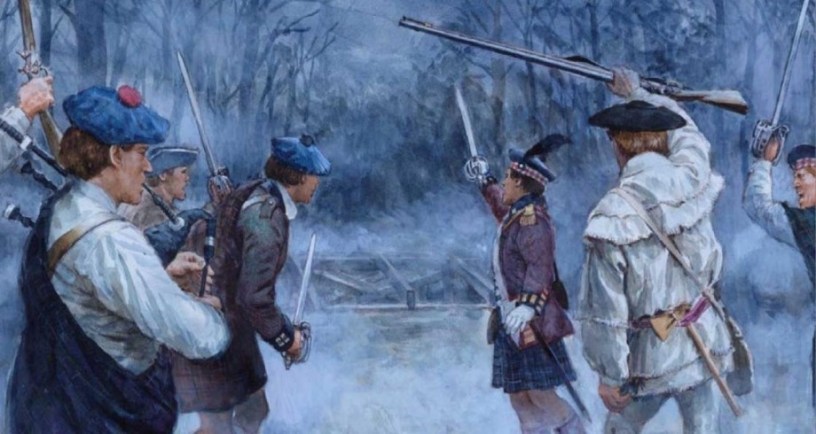
This bitter ideological divide culminated on 27 February 1776 at the Battle of Moore’s Creek Bridge near Wilmington, North Carolina. A Loyalist army composed almost entirely of Scottish Highlanders marched to join British regulars.
Broadswords in hand, the Highlanders charged across a partially dismantled, grease-slicked bridge, shouting traditional Gaelic war cries.
They were met with devastating, coordinated gunfire from American Patriots waiting on the other side.
The battle was a rout; the Highland army was shattered, their leaders were captured, and the survivors faced years of brutal persecution and land confiscation.
The romanticism of modern historical fiction frequently superimposes twenty-first-century notions of liberty onto a deeply traditional, pragmatic people.
The real Highlanders of early America were not proto-democrats fighting for a new republic.
They were conservative, insular, and intensely loyal to their word.
In their eyes, the American Patriots were the lawless rebels, and the British Empire was the only guarantor of their hard-won stability.

