
BY AVELLINA BALESTRI
“The boast of heraldry, the pomp of power, all that beauty, all that wealth e’er gave awaits alike the inevitable hour: the paths of glory lead but to the grave.”
These lines from “Elegy in a Country Churchyard” by Thomas Gray are some of the most frequently quoted in English literature, thanks in part to British General James Wolfe, who is said to have recited them before the Battle of Quebec, insisting that he would rather have written such a poem than subdue the city come morning. The copy of the “Elegy,” which had been sent to him by his lady friend, Katherine Lowther, is preserved to this day, and we can still make out his annotations throughout. As a lover of poetry, with a tendency towards brooding, it is entirely in keeping with him, even on campaign.
Were his legendary remarks upon the piece hyperbolic? No doubt; Wolfe could certainly lean into that mode of expression in his letters. It’s part of his charm. Yet the poignancy of this young man being so set upon the goal of earthly glory yet acknowledging the transience of temporal goods is haunting nevertheless. Death is the great equalizer of all mankind, of princes and paupers, of victors and vanquished, of the famous and the forgotten. And so it is that “Jemmy with the tawny hair” is immortalized in ballads and paintings, perishing at the height of his achievement as Quebec falls under the Union Flag, while elsewhere, his French opponent, the Marquis de Montcalm lies stricken by his own mortal wound. Sic transit gloria mundi.
But I think it is a mistake to focus solely on the lines of “Elegy” involving glory and the grave; any study of this poem and its lasting impact is incomplete without considering the message contained within the eulogy of the Every Man in the final stanza:
“No farther seek his merits to disclose, or draw his frailties from their dread abode. There, they alike in trembling hope repose: the bosom of his Father and his God.”
Beyond the passing nature of all earthly glories, and the ultimate equality of the dead, rests a trembling hope for eternal life which proves to be an even more profound unifying force across the human experience. The poem is wonderfully Christian in its representation of God not as a distant force but as a loving Father, and as such, one might dare to say, it is shot through with a hopeful universalism that goes beyond the limitations of human memory that fame ensures for a brief span. We dare to see within ourselves, and our neighbors, some divine spark which even sin and death cannot altogether destroy thanks to the redemptive work of God among men.
I have mulled over this intimate conclusion frequently because of Wolfe’s dark nights of the soul that he chronicled in his letters, which made him feel unable to pray and caused him to question if there was such a thing as the immortality of the soul. He believed in God as the One who caused nature to flourish and dictated destiny within history, and believed the Creator deserved gratitude for any goodness that human beings happened to enjoy, but he leaned towards a deistic inability to believe that the Great Architect could truly care for him as an individual. He would struggle to live a moral life in keeping with soldierly discipline in accordance with the tenets of Stoicism, but often failing, mused that perhaps human nature was simply broken, landing upon an accidental Pauline epiphany.
Beyond striving to keep his passions in check and be useful to society, there was something in Wolfe that transcended his often biting wit and sometimes judgmental reactions to others and revealed a genuine compassion, because, as he once remarked, all people are in essence the same. There are stories aplenty that justify the description of him as a mix of “tenderness and fire.” One has him intervening to save a slave boy on a Royal Navy vessel from being flogged. Another has him sitting down with a soldier to give health advice because the poor fellow is suffering from water poisoning and weak on his feet. Another has him holding a sergeant’s hand after the man has been wounded through the lung, promising to have him promoted if he fights to breathe, fights to live. These actions, more than anything else, made his men mourn their “red-headed corporal,” for he was truly “the soldier’s friend.”
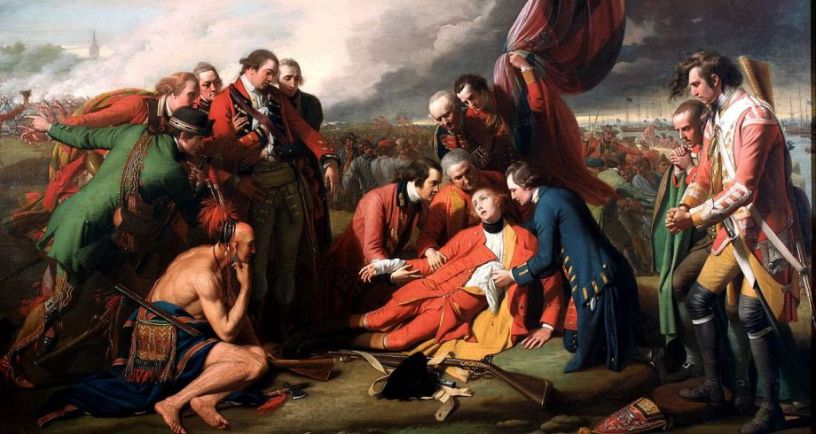
Wolfe also sought a transcendent experience in patriotic sacrifice, and for many in his era and those that followed, he became a secular martyr for the British Empire. Anglican England had largely turned its back upon her traditional saints, so the vacuum was bound to be filled by alternate sources of emulation. A statue of Wolfe was even erected to replace St. John the Baptist in the city of Quebec, and it is hard not to see inspirations taken from the Pieta and the Last Supper in the engravings and paintings that proliferated after his death. And yet, while pouring himself into earthly ambitions, he never ceased to ponder if there was anything more, and be grateful for the glimpses he received, sending his Catherine the image of her he carried, posthumously surrounded by jewels, as a parting gift in return for the poem she had sent him which spoke of the divine bosom as a final resting place.
Among his last words, he returned to his focus upon providence, to which he had committed himself before sailing off for his final campaign. “God be praised,” he said as he bled out upon the victorious field, channeling King Henry V in his Te Deum. “I die contented.” What sort of contentment? In doing his duty, in doubt, setting the stage for Lord Nelson’s words once the century had turned. But was he truly convinced that such things would be lasting? I think not. Likewise, I find myself pondering yet another enigmatic statement he made to the young aide who caught him after being shot in the chest: “Don’t grieve for me,” he said, trying to comfort him. “I will be happy in a few minutes.” Was he speaking merely of winning the battle? Or was he latching on to some trembling hope beyond that? Did he even fully know what he meant, or was he hoping beyond his own hope, as human beings, by the grace of God, will do?
And now, I call to mind one of my pilgrimages to Old England, the Mother Country, which will always possess a good portion of my heart. Arriving in Westerham, in the county of Kent, where James Wolfe was born, we made our way into the church of St. Mary’s where Wolfe’s family once attended and he had been christened. We had not even known this was the place to begin with; we just needed a parking lot to pull into and regain our bearings and we sought out the military hero’s statue which was said to be in the center of the village. Both the ghosts had their will with us, as I suppose I always imagined they would.
The church building dates back to the Middle Ages, when Catholic Masses would have been celebrated there, but has mementos of every age, including memorials to Anglican parish life and war dead from the 18th, 19th, and 20th centuries. One plaque to the dead of the world wars reads: “They died that England might live.” A stained-glass window of Saint George in a side chapel likewise demonstrates that this community, down through the generations, has kept alive its memories of warrior prowess and patronage.
At the front of the church, not far from the communion table, I sang one of the ballads in honor of General Wolfe, which placed an emphasis on his love for his soldiers, devotion to his country, and farewell to his aged mother, which could not help but help but move me, having finally returned to Old England after so long away, thinking of him dying so far from this place.
Bold General Wolfe to his men did say:
Come, come my lads, and you’ll follow me
To yonder mountains that look so high
All for your honor, all for your honor,
All for king and country.
Do you see the French on the summit high
While we poor souls in the valley lie;
Do you see them falling like dew in the sun?
Through smoke and fire, through smoke and fire,
They’re falling from our British guns.
The next broadside that they gave to us
Did wound our general in his right breast
And from his breast precious blood did flow
Like any fountain, like any fountain
And all his men were filled with woe.
Yes, the next broadside that they gave to us
Did wound our general in his right breast
Yonder he lies, for he cannot stand,
Yet fight on boldly, fight you on boldly,
While I have life, I will command!
Here are my treasures all in bright gold
Take them and part them; me blood runs cold
Take them and part them, General Wolfe did say
Brave lads of honor, brave lads of honor
That gave the French such gallant play.
When to Old England you do return,
Pray tell my friends I am dead and gone
And tell my tender old mother dear
Not to weep for me, not to weep for me
I died the death I wished to share.
It’s fifteen years since I first begun
All for the honor of George our king
Let all commanders do as I did before
Be a soldier’s friend, my boys, be a soldier’s friend, my boys
And the boys will fight forever more.
We walked back outside, and while gazing out at the absolutely gorgeous countryside beyond the lichen-covered headstones in the churchyard made my eyes fill with tears. For a handful of moments, as the sun played hide and seek from behind the clouds in a very English sky, casting pale autumnal light upon the gloriously green farmland, I thought I glimpsed what his hope might have looked like, an intuition beyond words, as the life’s blood pumped out of him and he insisted that his aide should attend to his own wounds instead. I thought I saw through a glass dimly a reflection of the next world in this one. And perhaps Wolfe saw it too, a reflection of the place where he was born, and so let himself bleed unperturbed.
And then one of my British friends said, “Have a taffy,” as only a Brit can do, and brought me back to this side of the mysterious mirror. The blue raspberry flavor of the candy was even more tangy through the tears I quickly brushed away. Then it was off to find Wolfe’s statue on the village green, and I bid adieu to that little plot of perfect England that seemed to me like a Maryland away from Maryland, a home that gave birth to home.
We finally succeeded in our quest, locating the village green by way of map-questing the Grasshopper-on-the-Green pub nearby. This village was replete with medieval pubs; nearby, there is another, called “George and the Dragon,” from the 15th century, hearkening back to the stained glass in the church. We arrived just as the sun was starting to set, but the sky had settled into a wondrous blue color, almost piercing in its intensity, like those who knew him said Wolfe’s eyes used to be, like a flame imprisoned in crystal. No one could forget him, if he looked you straight in the face. You’d follow him through fire and water to be of service to him.
At last, in front of his statue on the green, I sang another ballad over the din of traffic. Unlike the first song, which sprang up in this ancient land, this song first appeared amongst British Americans in the New World of my birth, emphasizing his parting from his lady love and fraternity with his French opponent. It was taught to me by my music teacher, who died earlier that year, adding to a sense of thinness between those who dwell in the now, and those outside of time. It was this ballad that first caused me to research Brave Wolfe, the man, and find myself moved to tell the tale, again, and again, on either side of the ocean’s expanse.
Come all you young men, all, let nothing fright you
Nor your objection make, nor let it delight you
Let not your courage fail till after the trial
Nor let your fancy move at the first denial.
I sat down by my love, thinking to enjoy her
I took her by the hand, not to deluded her
When I attempt to speak, my tongue doth quiver
I dare not speak my mind whilst I am with her.
Love, here’s a chain of gold, long time I’ve kept it
Love, here’s a ring of gold, madam, if you’ll accept it
When you this post read, think on the giver
Madam, remember me, or I’m undone forever.
So then this gallant youth did cross the ocean
To free America from her invasions
He landed at Quebec with all his party
The city to attack, being brave and hearty.
He drew up his men, in a line so pretty
On the plains of Abraham before the city
A distance from the town, the French did meet him
With double numbers, they resolved to beat him.
The French drew up their men, for death prepared
In one another’s face, the armies stared
Whilst Wolfe and Montcalm together walked
Betwixt their armies, they like brothers talked.
Then each man took his post at their retire
So then these numerous hosts began to fire
The cannon on each side did roar like thunder
And youths in all their pride were torn asunder.
The drums did loudly beat, colors were flying
The purple gore did stream, and men lay dying
When shot off from his horse fell this brave hero
We’ll long lament his loss in wealds of sorrow.
The French began to break, their ranks were flying
Wolfe seemed to revive while he lay dying
He lifted up his head where his the cannons rattle
And to his army said, “How goes the battle?”
His aide-de-camp replied, “‘Tis in our favor!
Quebec with all her pride, nothing can save her!
She falls into our hands with all her treasure!”
“O then,” replied Brave Wolfe, “I die with pleasure.”
Strange news is come to town, strange news is carried
Some say her love is dead, some say he’s married
Strange news is come to town, she fell a-weeping,
They stole her love away whilst she was sleeping.
I conclude the performance with a recitation of Gray’s final lines, an epitaph that is all too fitting for this complex yet endearing object of my scholarly affection.
Back at my hotel in Cambridge, after uploading the recording of my performance in front of the statue to social media, I was rather astonished as the number of views and likes it garnered, becoming my most popular I had recorded to date. Simultaneously, while flipping through the television channels, a program about railway journeys in Canada came on. Before I knew it, an engraving of none other than “Jemmy with the tawny hair,” gallantly leading his men with sword drawn, as he is depicted in his statue, and I screamed as if I had seen a phantom materialize in front of me. Judging from his letters, Wolfe always had a sharp sense of humor. I can’t imagine it has grown dull elsewhere. And that is why, thinking back, I dare to smile when I pray for him.
May we all cling to trembling hope, each and every one, on our journey home.
Requiem et pax, Red-headed Corporal.
 Fellowship & Fairydust