
BY CLAY RAMSEY
Camp of the 2nd Spartan Regiment, or the Fair Forest Regiment, somewhere in Union County. Commanded by Colonel Thomas Brandon. Very Early One Morning in August.
Colonel Bradon is a man fueled by hot, passionate hatred of Tories. Tolerance is a virtue he will not tolerate. To his way of thinking, there is but one way of thinking and living – to love liberty and fight for it, or get out of the way. Americans who kneel and bow to Kings and Princes, and Lords and Ladies, in order to gain preferment and power over their neighbors, are worse than the British themselves. They should know better. They will live long enough to regret their errors.
The Colonel has always considered Tories as traitors to their True Nation, but now his hatred is fed by the memory of the terrible morning of June 8th, just three months earlier. On that day, Tory scum had killed his own dear nephew, John Young, along with four other men of his regiment. Brandon had established a camp near Fair Forest Creek as a place to launch patrols to keep the Tories in check, and as a place to hold prisoners. One of the damn, conniving, lying, thieving prisoners had escaped, an Adam Steedhan by name. He raced immediately to the camp of the Tory Bloody Bill Cunningham. Just after sunrise the next morning, Bloody Bill added more blood to his score. They killed five of Brandon’s men. Most of the rest escaped by jumping into a deep ravine where the Tories feared to follow. The Colonel himself had not been in the camp, but he lived with the weight of the great personal loss, and notoriety of what was now called Brandon’s Defeat. He now exacted revenge at every chance in the field, and he drew consolation from the knowledge that John Young’s younger brother, Thomas, had ambushed, captured and hung the swine Steedham from a tree.
On this particular morning, the Colonel was hard at work preparing for his next attack. “Come on, boys, let’s get these knocked together securely! When they are done and loaded on the wagon, we are done until nightfall.” The Colonel was not a man to be ignored. He was a big man, over 6 feet tall, and loud, burly and authoritative. Three groups of men worked on putting together large, heavy crosses which were laid out on the ground. One looked to be about 20 feet tall. The other two were about eight to ten feet tall.
The Colonel called out, “Now listen up, lads. This is not difficult. Take your axes and cut a notch a couple inches deep into your uprights. Size them to accept and hold the cross pieces snuggly. Then drive in a couple spikes to hold them, and for good measure, lash the members together with the heavy rope that is over in the wagon.
One of the men called out, “Colonel, Sir, this monstrous big one here. It is obviously for Christ. Is this the one you will be occupying?”
“No,” shot back the Colonel. “Remember your rank, Little One, which is NOTHING. Lower than Nothing. Save your little wit for the damn Tories. These crosses be for lying, cheating, backstabbing Tory scum and thieves. When they have paid us in their own blood for their crimes, then you may laugh and joke, if you wish.”
“When the crosses are stout as can be, load them into the wagon. Leave the wagon in the barn, and come on down to the camp. Oh, one more thing, a couple of you go into the woods over there and gather up a bunch of grape vine. That will look very nice wrapped around the crosses like wreaths. Get them decorated like that, then come to the camp.”
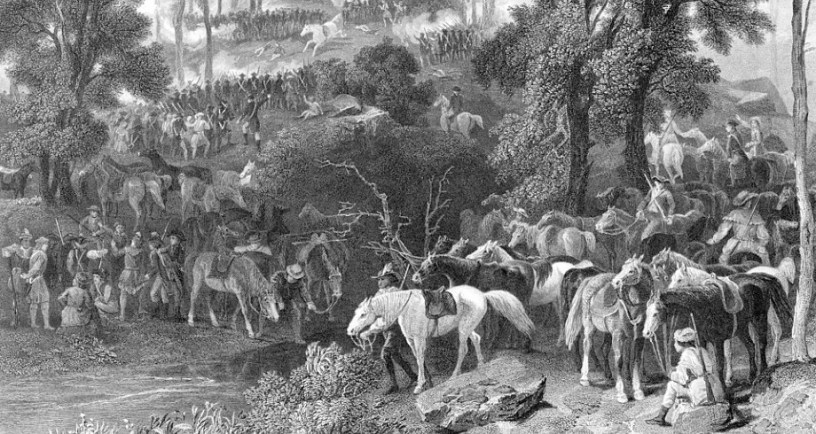
The camp was in a little hollow along a creek. Men were getting ready to break camp after a week here. It was a rule not to stay too long in one place, because locations are never secret long. Some were organizing and packing, while others were still finishing breakfast. Colonel Brandon strode down to the creek where a black man had a mighty good looking breakfast sizzling in an iron skillet.
“David, my man,” said Brandon, as he put a hand on the man’s shoulder. “That looks mighty appetizing. Do you have a little for me?”
“Colonel, you knows I always got a meal for you. Whys you ask such a silly question? Roll that log over and have seat here.”
Brandon took the offered log, a plate, and a fork and he dug in, as usual. He looked at David, winked and said, “What would I do without you, David?”
“You be lost most of the time, is what.”
David had not always been David. He was Naruna as a child, and he was a slave on Brandon’s plantation. By the time he was a young man, he had become quite a hand at all the work around the farm, everything from carpentry to farrier work, training horses, and caring for the sheep and cattle. Brandon considered him indispensable. As the War heated up between Tories and Patriots, it seemed that life had become a long series of raids, burning homes, and killing off neighbors while protecting one’s own.
On one occasion, Colonel Brandon had set up a plan for an ambush. He had deployed his men in dense woods along a horse trail the Tories would take to attack his camp on the Tyger River. That camp was bait. Brandon had let word of the location slip out. Spies had told him the Tories would attack that morning. Well before dawn, he had his men hidden in the dense foliage along the trail. The horses were picketed over the hill. Colonel Brandon watched and waited for the right moment to attack. Naruna was at his side. In the half-light, Brandon counted about twenty riders, silent and on edge as they approached the camp.
Brandon noticed a big man bringing up the rear of the Tory mob. He was alert. A lookout, and he was loaded for bear, with two sawed off muskets hanging from his saddle. Brandon wanted to take him out quietly, ahead of the attack. More as a joke than anything else, he picked up a good, fist-sized rock and showed it to Naruna. Then he pointed to the man, and he took the rock up to his own head, as though hitting himself. He gave Naruna the rock. Naruna stood up very quietly, and when he had the closest and best shot, he let it fly. It hit that man right in the temple with a mighty force, knocking him unconscious and right off his horse. Colonel Brandon let out an Indian war whoop, and his men stood and began firing. Having fired, they charged with knives and tomahawks.
Out on the trail, Brandon was jumping up and down, shouting in glee. “Naruna, what a man you are! You are no longer Naruna! I dub thee David, the Giant Killer. Little David with his rock took down Goliath, with naught but the power of his arm and the will of God. David, who used to be Naruna, you are no longer a slave. You have earned your freedom!”
That had been nearly a year earlier. David was now as much a part of the 2nd Spartan as anyone. This morning a new attack on Tories was in the works. Colonel Brandon had his target, perhaps the most prominent leader of Tories in the area. The man had prospered by stealing from area Patriots with the support of the British. He and his men burned farms and homes, chased off the owners, and took possession themselves. His mill had flourished, doing great business in support of the British forces. Fearing reprisals, this fat Tory had turned his home into a little fortress. The exterior walls had been doubled up with an outer exterior wall, and the space between had been filled with clay, making the walls almost impenetrable. Colonel Brandon planned to put that fortress to the test that night. But that was hours away, and he meant to enjoy his day.
Brandon stood up from his breakfast seat, , his arms out high, and rose up on his toes, stretching his whole body, then he dropped his arms, put hands on his waist, and he twisted side to side, stretching out kinks in his back, then he bent a dozen times, touching his toes. He looked over the camp for a moment, then said to David in a ridiculous, pompous British accent, “ I say, old chap, ‘Pon my… ‘Pon my. . . “
David rolled his eyes. “I believe you mean to say, “Pon my sword,” Colonel.
“Yes, yes, right you are, young David. Some old British fart may say “ ‘Pon my word,” but I say ‘Pon my sword. That is how the Lord’s work is done here. Where is my sword, David?
“Right here, Sir,” said David, as he stepped over to a pile of gear and picked up a long and heavy sword in a scabbard. He handed it to the Colonel. Brandon beamed with pride as he pulled the blade from the scabbard.
“Ah, this is a fine weapon here, David. Made by smithy Darby from a huge old mill saw blade I took him. It is stout and tough, and unlike any other,” said the Colonel.
“‘Dat’s the truth, Sir. Deed it is.” David had heard the story of sword many times, and always his response was the same.
“David, when you have time during the day, please take your whetstone to my sword. I would like it ready to cut clean tonight.”
“Colonel, tonight be like the scythe of Jehovah, reaping the wicked.”
“Let it be so, David. Let it be so. I am going to pass some time with the men.”
The Colonel wandered among small groups of men who were scattered about the banks of the creek, most kneeling on the balls of their feet, as country people do. Brandon knew virtually all of the men pretty well, and their families, though there had been a few new recruits lately. He asked questions about families, and any news he should know, any situations where he might be able to help. Eventually, he was well satisfied that his men would be fine that evening. He scanned around the field with something in mind, but then his eye caught a tent which he had not noticed. He strode over, threw back a flap and saw a very large, very unkempt man, on hands and knees, looking out.
“My God!” roared the Colonel. “What have we here? Come on, out! Or I shall send in the bear!”
The man crawled out of the tent and stood slowly. He obviously had been sleeping late.
“Mister, are you part of my regiment? I do not recall you, and I would be unlikely to accept such a … such a misfit, into MY regiment.” Getting right up into the man’s face, Brandon shouted, “What is your name, Sir?”
“Most people just call me…the Fat Man!”
“Well, I can certainly see that, no doubt. But that will not work here. Do you know that the fat ass Tory we are attacking tonight is known to us as The Fat Man?”
“No, sir, I did not know.”
“Well, your family, what do they call you?”
The man looked down, not wanting to look eye to eye with the Colonel. He mumbled a reply, which no one understood.
“Come on, man, say it out. Have some pride in your name and person, or you will never be a part of this regiment. It is a damn poor dog that won’t wag its own tail. Now, again, say it loud and proud, Mister!”
The man, though trembling, shouted out, “They call me George, sir.”
“Well, that is not much of an improvement,” said the Colonel, as he backed a couple steps, then looked George over carefully, front, back and sides. Finally, he said, “George, in our regiment, should we decide to accept you, you shall be known as Little John, just like Robin Hood’s mighty partner in Sherwood Forest.
“Now, Little John, tell me of your family, why did you come to join us? Who here can speak for you?”
“Beg pardon, Sir. My family is Tolliver, near Abbeville. I did not come to join sir, ‘twas an accident. I was tying to escape Tory villains. They burned everything on our farm, sir, and stole all our livestock. I know no one here to speak for me, Sir. I am here by pure chance, Sir.”
The Colonel looked skyward, raised his arms in exasperation. He looked around. ”Men,” he said, “how do we have a stranger among us, sleeping in our camp all night long, and no one noticed?” The Colonel saw and heard nothing but mumbles of embarrassment.
“Litte John, from your story, you have good reason to join us, but know this: If you do not convince me by the end of the day that you can be trusted, you will be tightly bound to a tree and gagged. You will be that way all night, so think about that, as the day goes on. If we really find reason to distrust you, we might just cut your throat and throw you in the creek.”
“Now, 2nd Spartan, I must tell you that you failed the mental acuity test, not one of you having noticed a total stranger in residence in our camp. We shall set that aside for now and move on to physical performance.
“Sargeant McIntire, you know how we run our drills. You are in charge. Let me know any slackers, and the most outstanding runners.
“Men, you know we desire fitness for speed and stamina, NOT to be able to run away from our enemy, but to RUN DOWN our enemy and to deliver the coup d’grace.
“Little John, as this is your first day, and you are manifestly unfit, you may start slowly. You are to run laps around this field at the best speed you can manage. After 4 laps, walk a lap. Then 4 more at a run, and so on.”
A good part of the day was passed in this way. David won all the sprints and medium distances. A tall, rail-thin man named McAndrews, who was a well known, long distance hunter, easily won the longer runs. Little John, all things considered, performed satisfactorily, and with good spirit.
After running there was a long break for relaxation, after which the Colonel stood and announced the next event loudly. “Men, it is now time for our show of strength. For the sake of making this quick and easy, the contest is limited to one event – arm wrestling. Same rules as always. All men who lose to me, owe the Regiment one half Spanish dollar. As you know, that money goes to the needs of the Regiment, and our families. It has been a great money raiser in the past, as no one has yet beat me. I will remind you, if I am beat, I myself will contribute the full amount to the Regiment fund.
The Colonel stripped off his shirt, and, as always, his muscular physique impressed all. He banged his fist down on the heavy wood top that had been attached to a barrel. “Here I am, men. I stand ready to take on one and all. Take a few minutes to consult the order in which you want to try me. Perhaps you want to save your best for last, once I am a little fatigued. Just let me splash myself with some cool creek water, and I will be ready to go.” The Colonel returned, freshened from the creek and strode towards the table, where he saw Little John, all 300 pounds of him on a six foot, 5 inch frame.
The Colonel laughed, shook his head and went right to the table, staring Little John intently in the eyes. A cold, stony stare. “Men, you are going to be disappointed. You think you can win on size alone. Yes, our new boy, Little John, is a big one, but is there muscle in all that fat? We shall test it. And heart, and grit. Little John, you have not yet been tried by war. Our little game will show what you have got.”
Both men put elbows on the table and gripped hands. It was indeed a noble contest of strength and endurance. After twenty minutes, it was over. Little John raised both of his huge arms in triumph, and the men cheered him and clapped him on the back. The Colonel shook hands, acknowledged the victor, and guaranteed his large personal contribution to the Regimental Fund.
The last event of the afternoon involved a skill which could be quite useful to a mounted infantry unit like the 2nd Spartan. It was the pick up race, in which a rider races up to rescue a compatriot on the ground. The rider holds out a crooked arm. The man on the ground hooks it with his own arm and swings up onto the back of the horse. That is the idea, but most of the men on that day proved that they had a lot of work to do on that skill. It was comical to see bodies flying and falling, never making it onto the horse. One team executed it perfectly. That was the Colonel and David.
As dark was approaching, Colonel Brandon sent the wagon bearing the crosses on ahead with an escort of six riders. It was a 15 mile journey, and the wagon would travel more slowly. It was a lightly used trail between several plantations. With any luck, they would encounter no one.
While the men ate supper, the Colonel reviewed assignments. A team of five archers was to position themselves in the woods on the hill opposite the mill. When they saw the flaming crosses, they were to shower the roof of the mill with fire arrows. Having done that, they were to circle around to the front of the mill, which faced a large barn across the road. They were to set that on fire as well. By that time, people would be coming out of the houses and the mill. Then it was to be take no prisoners, free fire, except they must take care to shoot no women or children. The memory of the accidental shooting of a Tory wife at the battle of Stallions still troubled Brandon greatly. When they had created sufficient havoc and destruction, Brandon would have a bugler blow retreat.
The time to ride was getting near. The men were saddling up and checking their gear. The Colonel was seated on an upturned log beside a fire, poking in the hot embers with tongs. Across his lap, he had a musket. He picked up a red hot piece of metal from the embers and applied it to the musket stock. Smoke rose up as the metal seared the wooden stock. He repeated this several times, then he poked around again in the embers and came up with a second piece of metal, which he likewise applied to the stock. He then stood and walked to an open spot among the men and horses. “Little John,” he called out, “step forward, front and center.” The big man did step forward, obviously nervous at being the center of attention.
“Little John,” the Colonel said so that all could hear, “do you of your own free will wish to join the 2nd Spartan Regiment?”
“Yes, Sir. I do.”
“And do you recognize that all men of the 2nd Spartan are your brothers, and that we fight and we prevail as brothers, and when any brother falls, we bring him home?”
“Yes, Sir, I do.”
“Men of the 2nd Regiment, what do you say to Little John? Do you accept him as your brother?”
There was a loud, immediate, unanimous “Yes, Sir!” That was followed by loud cheering. They cheered the unexpected Fat Boy who beat their Colonel in strength of arm.
“Private Little John, this is your 2nd Spartan musket. Use it well.” Little John took it, looked at it, and he grinned broadly when he saw L J burned into the musket stock.
The men were beside their horses, awaiting the command to mount. Colonel Brandon went to his own horse, drew his sword from his scabbard, stuck the point into the ground, and he went to one knee. He bowed his head.
“Heavenly Father, we ask your protection and guidance in our mission tonight. We do not lightly take up sword and shield and implements of war, but war has come to us. All of us here tonight have lost friends and family to these enemies in our land. Our strength alone is small, but through you, all things are possible. Tonight we pray that through the corrective power of our arms, and your divine light, that our enemies might see the error of their ways. In all things, we seek always to be thy agents. Amen.”
“Mount up, boys,” the Colonel called out. “Let’s ride.”
It was dark, but the Spartans kept up a brisk trot, with the Colonel and David at the head of the column. They would do most of the 15 miles at a trot. The less time spent crossing country, the better. Brandon asked David to slip back to find McBride to ask him to ride up front with them. McBride was a promising young man, about 20 years old. His father and brothers were also Spartans, but they were not on the mission tonight. When McBride got up alongside the Colonel, Brandon asked him how he felt about the mission. Was he confident in his part of it? “Yes, Sir,” the young man replied. “Not the slightest doubt.”
“That is good. Confidence, and understanding the plan is halfway to victory. Now, the reason I called you up here, Nathan, is that I am very sorry that I was unable to attend your marriage. You and Peggy and your unborn child are in our hopes and prayers. I have a gift for you which I hope you will always be able to keep. It is three gold coins, symbolic of your family, of what you are, and the genesis of what you will be. There will be difficult days when spending this money could solve problems, but I urge you to consider that a last resort. Every family should have things sacred to the family – memories, little treasures, the family Bible. You have been through the fires, Nathan, and there are more to come, but you and Peggy will come through the fires and be the people of purified metal needed to build this country. You take care, Nathan, and trust that no matter what happens, God is watching over you.” Brandon handed Nathan the coins, which were on a little gold chain. He shook Nathan’s hand, clapped him on the back, and then he spurred his horse and rode on ahead.
The column caught up to the wagon crew a few miles short of the target. They rode silently, but in growing excitement. The night was quiet. They had seen no one, and no one had seen them. They would have time to get into their positions. The big cross was to go near the top of a small, cleared slope above the mill. The other two were to be to the right and left, slightly lower down the slope. The men detailed as the cross escort were to stay with the crosses, and to set them up with their bracing boards. They would then await the command to set them on fire.
The archers went on ahead to allow themselves time to picket their horses well out of sight and hearing. From that point, they would walk to their positions on the hill above the mill. The rest of the men positioned themselves around the front and sides of the mill. In shooting range, but out of sight in the dark. The one fear they always had in these situations was dogs. They could only be very quiet and pray.
The signal to the men at the crosses was to be three flashes of a lantern. Light was emitted from one side, only when the door was opened. They saw the signal and lit the oil soaked crosses, which almost exploded in fiery flames. Then the archers began their shower of fire arrows on the mill. Not every arrow caught fire, but enough struck home to do the job. The archers then quickly slipped around the mill, across the road, to set the barn on fire. This, too, was soon blazing.
By this time, people were running from the mill and the houses. The men carried muskets or rifles, but they were useless against invisible raiders. The women and children ran for cover. The men were easy targets, highlighted as they were by firelight. For the Spartans, it was like shooting ducks in a little pond.
There were still three Tories in the road, looking into the night in frustration for targets that they could not find. Those three did not have a chance. Colonel Brandon came charging down the road wielding his mighty sword. The first two men fell to fatal blows, but the third ducked slightly and managed to parry with the barrel of his musket. Still, a powerful blow fell upon his skull. He fell to the ground, a bloody mess. The Colonel wheeled around and saw that the man was still alive, though one eye was out of its socket. The Colonel then looked at his blade and was stunned to see that it was badly bent. His mighty blade bent and the scoundrel still alive. The Colonel called to David who had charged with him.
“David,” he said. “bind up this man’s wound. He may live. The knucklehead bent my sword. A man hard enough for that deserves a second chance.”
To the bloody man, Brandon said, “I do not give many second chances. This would be a good time to see the light and change your ways. We are all given a moment in time to come to Jesus. This is yours, Brother.”
The Colonel began studying his sword. He held it out straight before him, looking at the bent spot, squinting down the edge in the half-light. Damn. Perhaps it could be mostly straightened in a forge vise, then heated and pounded. He shook his head.
He got off his horse and stepped over to the bloody man on the ground. He knelt down to look the man in the eye. The one he had. Brandon tried not to focus on the one that rolled around on the man’s cheek.
“What’s your name,” asked Brandon.
“John Houston.”
“Well, John, thanks to me, if you live, you will be a more colorful character in the rest of your life. From now on, you will be known as One-Eyed John Houston. Up to this point, you have lived as a low-life, Tory scum land pirate. Well, now you will look a pirate indeed. You might get yourself a parrot.” Then Brandon bent over and whispered in the man’s ear, “This is your time, Brother.” *
The Colonel surveyed the scene. The fight was over, the damage done, mission accomplished. He searched around for David. There he was. “David, he called out, “Have Retreat sounded.”
* * * * * * * * * *
The Regiment was gathered around the Colonel at the top of the little hill across from the mill, which was a still-growing, massive blaze, as was the barn. On the little rise below the mill, the three fiery crosses burned. The crosses themselves could be clearly seen through the flames. “That is a sight always to remember, boys. The cross of Jesus, and those of his two companions, common thieves. But one of them believed and called Jesus and was saved and taken to Heaven. Remember that, because we, too, are sinners, and we believe. We believe in Jesus. We live, and we fight in his name. We believe. We call on him, and we shall prevail.
“Now, the word is out about our little sortie. We have killers hunting for us. Let’s head home. Scouts out in front, rear guard behind, outriders when feasible.”
This story is excerpted from the historical novel Fire, Brimstone and Blood by Clay Ramsay, available through Fires of Freedom Publishing.

