
BY LEAH FISHER
In 1943, Dietrich Bonhoeffer wrote to his fiancée: “Don’t say anything about the ‘false picture’ I may have of you. I don’t want a ‘picture,’ I want you; just as I beg you with all my heart to want me, not a picture of me—and you must surely know that those are two different things.”[1]
There has always been a strained relationship between reality and portrayal in media for Dietrich Bonhoeffer, the controversial twentieth-century Christian theologian who, to this day, ignites debate over Christian action in a sin-drenched society. Perhaps it is appropriate that a man who professed to have “learnt the arts of equivocation and pretense”[2] and spent the last years of his life as a double agent, keeping a false diary, would find himself misunderstood. For a man whose image is so often hijacked for the sake of the creator’s desired message, it is almost refreshing to see him in the inconsequential role of a cameo character.
“With Wings as Eagles” reads more like a folklore legend than historical fiction. The screenplay was written by Braveheart screenwriter Randall Wallace, adapted from the novel Osterman’s War by James J. Cullen. Having no familiarity with the novel,[3] I will strictly address the writing of the characters and story as portrayed in Wallace’s screenplay.
The screenplay tells the story of Nicholas “Klaus” von Osterman and his family. Osterman is presented as an incarnation of the Übermensch, the Nazi ideal of a human. He’s handsome, incredibly fit, supernaturally strong, even indestructible, and he is the leader of an elite league of SS men called the “Black Eagles.” Osterman is such the perfect German that he is the man on the state propaganda posters. While Klaus is on daring combat missions on the Eastern front, winning battles with odds of 200-to-1, toughing-out bullets and rising from the dead, his brother, a crippled pastor named Reinhold, is busy plotting treason in his church basement. This is where Bonhoeffer enters the picture. Reinhold Osterman is part of a conspiracy network, the workings of which remain allusive throughout the screenplay. The network appears to be related to the Black Orchestra (the military confederation of republican monarchists). The Black Orchestra connection is indicated through the identities of those at the meetings. The participants are described as German officers and dissenting clergy. Dietrich Bonhoeffer and Wilhelm Canaris, the German spymaster and leader of the Abwehr, are the only historical characters mentioned by name, appearing for cameos in a few short scenes. In the end, the various storylines remain largely unresolved and those which are resolved leave a distinct impression of unbelievability. Characterization and sanity, it appears, were not integral parts of this story.
As happens to all dramatized Bonhoeffer media, the timeline of the story is in a state of total confusion. The story, which seems to take place over a matter of weeks and is entirely restricted to a singular winter outside of the holiday season, combines a number of elements which would leave anyone with a knowledge of events (be they related to the war or Bonhoeffer and the Black Orchestra themselves) in a state of utter confusion. It’s winter. The Russians are slowly pushing back the German advance. The Americans are preforming bombing raids on Berlin. All of this points to the idea of the story taking place in the early months of 1944. This would also be consistent in lining up with the increasingly desperate actions of the Black Orchestra, which saw its final coup attempt go out with a bang on July 20th of that same year.
However, this timing would be inconsistent with the participation of Bonhoeffer and Canaris, both of whom were no longer directly involved in operations. Canaris’s involvement is defensible if the story is set in January of 1944, but no later, as he was dismissed from his post in February of that year. Canaris’s dismissal accompanied the abolition of the Abwehr, and a key branch of the military resistance network along with it. However, Bonhoeffer’s involvement in Osterman’s plot is entirely unworkable, because he was arrested along with his sister and brother-in-law, Hans and Christine von Dohnanyi, the previous spring. At the time of these alleged conspiratorial meetings in the basement of Reinhold von Osterman’s church, Dietrich Bonhoeffer would have been locked away in Tegel Prison, penning poetry and playing the part of a chaplain to his fellow prisoners. But the whole timeline falls about further, because the screenplay concludes in an epic battle between Klaus von Osterman and the Nazis amidst the Russian invasion of Berlin. That specific event ties the story to the timeline and cements it in April of 1945, later than even something as simple as the Nazi’s use of resources to hunt Klaus and his escaped American POWs stands against the most basic scrutiny. What’s more, the Battle of Berlin began on April 16th, while both Bonhoeffer and Canaris were executed on April 9th (along with the remainder of the Abwehr conspirators).
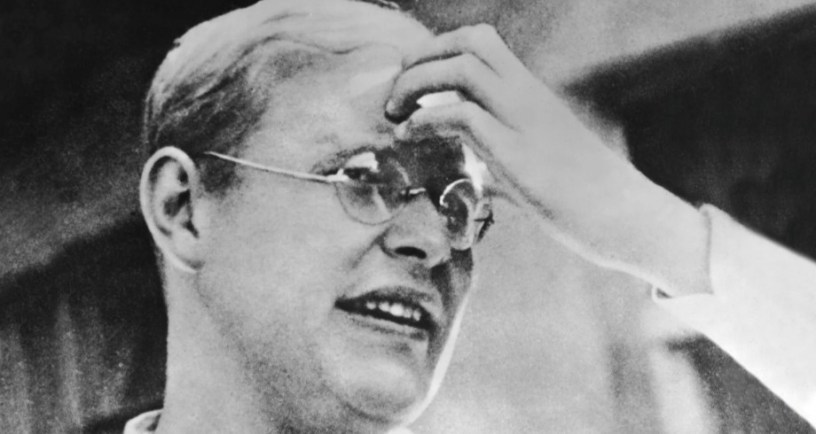
Bonhoeffer himself doesn’t say enough to feel like an actual person. Apart from the fact that Wallace’s description of the theologian seems strange, it is almost difficult to remark on his character, because his lines come across as generic dialogue meant to carry the story along than the intrinsic expression of a human soul. Bonhoeffer is described thusly: “He is a clergyman, in civilian clothes, in his mid-forties; he is stocky, and wears bookish horn rims. He has a gentle voice” (emphasis added).[4]
A clergyman? Fine. Civilian clothes? Fine. But Bonhoeffer was executed at the age of thirty-nine. He never lived to see forty, a fact which he himself had prophesied many times to the disgruntlement of friends and relatives.[5] Stocky? Bonhoeffer was six-foot-one, and notoriously athletic. He was distressed that he had put on a little extra weight while living in London in 1933–35, due to the constant invitations to share meals with congregants. However, by the time this story with Osterman is taking place, wartime rationing is in full swing, and Bonhoeffer was certainly past that. The description of his glasses as “bookish horn rims” strikes me more as creative license than an accurate description, an opinion which is consistent with the description offered by Bonhoeffer’s assistant, Eberhard Bethge, in the introduction to his biography, in which he says Bonhoeffer: “wore rimless glasses because of shortsightedness.”[6] And one of Bonhoeffer’s students described his teacher thusly: “A young lecturer…with a light, quick step, a man with very fair, rather thin hair, a broad face, rimless glasses with a golden bridge….[H]e explained the meaning and structure of the lecture, in a firm, slightly throaty way of speaking.”[7] In summary, Wallace’s is not the worst description of Bonhoeffer to ever be given, but it certainly is not the best.
Throughout the continued course of our examination of Bonhoeffer’s appearance in “With Wings as Eagles,” it is important to note that this character, referred to as “Bonhoeffer” in the screenplay is never actually given a first name. So, while I here refer to his showing up as a “cameo,” a representation of the real-life Bonhoeffer, who comes off in the story as a fairly generic clergyman, it is entirely possible that this is an original character with no relation to the historical person at all.[8] However, let us continue as if it is the historical Bonhoeffer with whom the story is dealing, as the novel may well clarify.
Of the three short sections in which he appears, there is a scene in which Bonhoeffer meets Reinhold in a café which somewhat mirrors an event in the life of the real-world theologian. Unfortunately, the changes made in the Osterman story make the story of much less consequence and relieve it of its existing nuance.
In the historical case, told by Eberhard Bethge (Bonhoeffer’s closest friend and partner in ministry), is as follows:
“It was 17 June 1941, in the village of Memel. That morning Bonhoeffer had been talking to Dr. Werner Wiesner at a poorly attended pastors’ meeting; in the evening there was to be a Confessing church service. That afternoon he was sitting with me in an open-air café just opposite the town, on the peninsula. We had come by ferry past submarine tenders and minesweepers. The previous day Stalin had delivered an ultimatum to the Baltic states, but the world’s attention was centered on Hitler’s victory in France.
“While we were enjoying the sun, suddenly the fanfare boomed out of the café’s loudspeaker, signaling a special announcement: the message that France had surrendered. The people around the tables could hardly contain themselves; they jumped up, and some even climbed on the chairs. With outstretched arms they sang “Deutschland, Deutschland uber alles” [the German National Anthem] and the Horse Wessel song [the Nazi Party Anthem]. We had stood up, too. Bonhoeffer raised his arm in the regulation Hitler salute, while I stood there dazed. “Raise your arm! Are you crazy?” he whispered to me, and later: “We shall have to run risks for very different things now, but not for that salute!”[9]
In his retelling of Bonhoeffer’s life, Bethge points to this as the moment when Bonhoeffer’s “double-life” began. The similar tale, as told by Wallace in “With Wings as Eagles,” is comparatively flavorless and reveals nothing of the pastor’s character.
The scene is introduced: “INT. BEER GARDEN – DAY,”[10] where “Bonhoeffer, the quiet clergyman from Reinhold’s basement meeting, sits at a booth table in the beer hall. Reinhold slides into the seat opposite him.” The two have a brief conversation about the recent death of Reinhold Osterman’s brother, the super-soldier Nicholas von Osterman (“Klaus”), —who, I will note, is not actually dead, and miraculously resurrects in the next scene, frozen and bloody on the Russian front, buried under a mound of dead bodies—and the conversation when turns to the present with the entrance of some SS soldiers. The scene reads as follows:
>>BEGIN<<
Reinhold looks away, keeping his emotions at arm’s length. From across the room comes a gale of laughter, as soldiers of the SS, their eyes haunted and strained, drink with bureaucrats who seems to have lost their grip on reality.
Bonhoeffer is about to speak when he spots a couple of men in trench coats entering, with some Brownshirts. He touches Reinhold’s arm to be sure he notices.
REINHOLD
Bastards. They know what’s happened on the Russian front. But they won’t tell those louts over there.
BONHOEFFER
I am sorry about Klaus. I know you two were close.
REINHOLD
He was the strong one. (laughs) I know that sounds funny, of course he was the strong one. But everyone always seemed to believe that I had the most inner strength. He protected me from bullies, from taunts and insults in the schoolyard. But my parents — and even Klaus himself — thought I was the one with the inner strength, because I had so much of that sort of thing to carry. (chuckles) Klaus used to say I gave him strength. Can you imagine! But he was the one… he was the one…
Suddenly tears are spilling from Reinhold’s eyes; he hides his face in his hands, and sobs. Then just as suddenly, Reinhold pushes back his emotions, and sniffs hard.
REINHOLD
But on to business. Has a decision been made on my offer?
Bonhoeffer nods. Across the room, one of the revelers sees the Brownshirts who have entered.
REVELER
Hans! What news from the Front?
BROWNSHIRT
We will slaughter the Russians until there is nothing left of them.
REVELER
Until there is nothing left! I’ll drink to that!
BROWNSHIRT
Sieg Heil! Heil Hitler! Heil Hitler!…
Everyone in the place gets up and starts the chant. But Reinhold’s grief flashes into anger, and he mutters through clenched teeth.
REINHOLD
They can kill me, but I’ll never give that salute.
Bonhoeffer leans across the table, his voice a hot, insistent whisper.
BONHOEFFER
You and I are going to die soon enough. But it’s going to be for more than this salute.
Bonhoeffer stands, pulls Reinhold to his feet, and throws their hands into the air.
BONHOEFFER
Heil Hitler!
REINHOLD
Heil Hitler!
And the secret police in the corner see it all.
>>END<<
In the screenplay’s Beer Garden scene, Bonhoeffer’s decision is not one of dissent into a life of conspiratorial resolve but of dismissive, almost uncaring nihilism, gilded with moral compromise. His actions are not explained. There is no point at which they are explored; and Reinhold’s moral whiplash is shocking. His willingness to change from boldly declaring he would rather die than offer the Hitler salute to offering not only the salute, but also the idolatrous utterance “Heil Hitler!” is unbelievable. While Bonhoeffer did eventually get to the place of keeping a Nazi-sympathizing diary and signing letters to the state “Heil Hitler!” as a cover, these were things that were done under considerable duress, at calculated points, and with the express purpose of covering over his resistance activities in the eyes of the state. Why Reinhold, who has up to this point preserved his ministerial work (even to the point of operating within the confines of the state-sanctioned framework), would embrace the kind of life that Bonhoeffer later declared “may prevent me from taking up my ministry again later on,”[11] without any resistance is beyond me. What’s more, it is also a far jump from Bethge’s description of universal national celebration at a great victory in war to a few SS guys getting a little crazy in a bar. The need to blend in is much greater in one case than the other.
In the end, “With Wings as Eagles” is a confused mess of sex and over-the-top action-movie violence superimposed on a historical setting, without any respect for the historical world itself. The characters remain underdeveloped and without nuance, serving as architypes, McGuffins, redshirts, and cameos, rather than actual humans. The story swiftly launches itself into a decided state of unbelievability and loses all weight or tension, whether it be internal or external, as the characters are quickly proved to be above death and moral quandary; nothing is a question for them, only a minor inconvenience which is quickly overcome without wrestling. And the moral Christian aspect, alluded to in the chosen title, is not embraced further than the presence of the pastoral characters and the voiceover of Reinhold von Osterman reading Isaiah 40:31 while his brother, the legendary leader of the Black Eagles, charges an SS barricade.
“But they that wait upon the Lord shall renew their strength; they shall mount up with wings as eagles; they shall run, and not be weary; and they shall walk, and not faint.”
– Isaiah 40:31 [King James Version]
Footnotes
[1] Dietrich Bonhoeffer, Love Letters from Cell 92: The Correspondence between Dietrich Bonhoeffer and Maria von Wedemeyer, 1943–45, ed. Ruth-Alice von Bismarck and Ulrich Katz, trans. John Brownjohn, (Abingdon Press, 1995), 340.
[2] See “After Ten Years” in Dietrich Bonhoeffer, in Letters and Papers from Prison: Enlarged Edition, ed. Eberhard Bethge, trans. Reginald Fuller and revised by Frank Clarke and others, (Macmillan Publishing Company, 1971), 16.
[3] Editor’s Note: According to the script’s cover page, Wallace wrote the screenplay based on Cullen’s then-unpublished manuscript in 1995, the same year he received an Academy Award nomination for Best Original Screenplay for Braveheart. “With Wings as Eagles” was never produced despite Arnold Schwarzenegger expressing interest. Wallace went on to write several World War II screenplays, particularly Pearl Harbor (2001). Cullen published his novel in 2001.
[4] All quotations from the 1995 draft of “With Wings as Eagles,” made available on The Daily Script and multiple other websites.
[5] For example, Julius Rieger recalls that Bonhoeffer “mentioned, incidentally and quite freely, how ghastly it must be to reach the age of forty—he would never live to see that. In fact his life ended nine weeks after his thirty-ninth birthday.” See Julius Rieger, “Contacts with London” in I Knew Dietrich Bonhoeffer, ed. Ronald Gregor Smith and Wolf-Dieter Zimmermann, trans. Käthe Gregor Smith, (Fontana Books, 1973), 96.
[6] Full quotation is as follows: “Dietrich Bonhoeffer was a powerful man. He inherited his tall stature from his mother’s side, the Hases and the large-limbed Kalckreuths, and his supple strength from the Bonhoeffers. His movements were short and brisk. […] A successful jumper and sprinter in his school days, he still competed with his students when he was a university lecturer. […] He bought good material for his clothes and wore suits appropriate to the country and climate in which he lived, although he did not dress to impress others. […] His head was round rather than long, but it did not look out of proportion on his broad shoulders. His short nose emphasized his prominent forehead and mouth. […] Dietrich [inherited] the blonde hair and blue eyes of his mother. His hair became thin early in life, and he wore rimless glasses because of nearsightedness.” See Eberhard Bethge, Dietrich Bonhoeffer: A Biography (Revised Edition), ed. Victoria J. Barnett, trans. Eric Mosbacher, Peter and Betty Ross, Frank Clarke, William Glen-Doepel, (Fortress Press, 2000), xvii.
[7] Rieger, I Knew Dietrich Bonhoeffer, 60.
[8] Editor’s note: Wallace mentions in a 1998 interview with The American Enterprise that he “grafted the story” of Dietrich Bonhoeffer into Cullen’s story, confirming this is the famous Bonhoeffer. See “‘Live’ with TAE,’” The American Enterprise vol. 9, no. 3 (May/June 1998), 22. However, the ambiguity Wallace accidentally creates by only calling the character “Bonhoeffer” in the screenplay underlines a common criticism of Braveheart and other Wallace screenplays: he seems more interested in a mythical version of the historical characters he uses than in their documented personalities.
[9] Bethge, Dietrich Bonhoeffer, 681.
[10] Editor’s Note: Standard screenwriting format is to open each scene with “INT/EXT” for “interior/exterior scene,” then the location, and “NIGHT/DAY.”
[11] Bethge, Dietrich Bonhoeffer: A Biography, 681.
Bibliography
Bethge, Eberhard. Dietrich Bonhoeffer: A Biography (Revised Edition). Translated by Eric Mosbacher, Peter and Betty Ross, Frank Clarke, and William Glen-Doepel. Edited by Victoria J. Barnett. Fortress Press, 2000.
Bonhoeffer, Dietrich. Letters and Papers from Prison: Enlarged Edition. Translated by Reginald Fuller and revised by Frank Clarke and others. Edited by Eberhard Bethge. Macmillan Publishing Company, 1971.
—. Love Letters from Cell 92: The Correspondence between Dietrich Bonhoeffer and Maria von Wedemeyer, 1943–45. Translated by John Brownjohn. Edited by Ruth-Alice von Bismarck and Ulrich Katz. Abingdon Press, 1995.
Rieger, Julius. “Contacts with London.” In I Knew Dietrich Bonhoeffer. Edited by Ronald Gregor Smith and Wolf-Dieter Zimmermann. Fontana Books, 1973.
Zimmermann, Wolf-Dieter. “Years in Berlin.” In I Knew Dietrich Bonhoeffer.

