
BY ALASTAIR JOHN REDMAN
Introduction
David Stirling was born into a world of tradition, privilege, and rugged landscapes, characteristics that would later define his unorthodox approach to warfare. Born in 1915 at Keir House, Lecropt in Perthshire, he was the son of Brigadier General Archibald Stirling and the Honourable Margaret Fraser. His lineage connected him deeply to the Scottish aristocracy and the martial traditions of the Highlands. This background provided him with a unique blend of confidence, independence, and a natural affinity for fieldcraft and outdoor survival. Raised in an environment where leadership was expected and physical courage was taken for granted, Stirling grew up with a restless energy that struggled to find focus within the rigid boundaries of conventional peacetime society.
His early life was marked by a series of starts and stops that gave little indication of the military genius that would later emerge. He attended Ampleforth College and later Trinity College, Cambridge, though his academic career was undistinguished, leading to his departure before completing a degree. Stirling was a man of action rather than contemplation, possessing a towering physical presence, standing at six feet six inches tall. His height and lanky build earned him the nickname “The Giant,” a stature that matched his grand ambitions. Before the outbreak of the Second World War, he trained as an architect, attempted to climb Mount Everest, and moved to North America to train for a trans-Atlantic flight. This period of his life was characterised by a search for adventure and a dissatisfaction with the mundane, traits that made him ill-suited for the bureaucratic structures of the pre-war British Army, but perfectly adapted for the chaos of total war.
When war was declared in September 1939, Stirling found his true calling. He initially joined the Scots Guards as a second lieutenant before volunteering for No. 8 Commando in June 1940. This unit was part of “Layforce,” a composite commando brigade sent to the Middle East under the command of Colonel Robert Laycock. The commandos were intended to conduct audacious amphibious raids against Axis forces in the Mediterranean, but the reality of the campaign proved frustrating. The British military hierarchy in Cairo was deeply conservative, viewable through a lens of strict adherence to traditional doctrine. Large-scale commando operations were frequently cancelled or mismanaged due to a lack of transport ships, poor intelligence, and an institutional resistance to irregular warfare. For a man of Stirling’s temperament, this inertia was intolerable, and it drove him to seek a completely radical alternative to the military orthodoxy of the day.
The strategic situation in North Africa in 1941 was critical. General Erwin Rommel’s Afrika Korps had pushed British and Commonwealth forces back across the desert, threatening the vital Suez Canal and the oil fields of the Middle East. The vast, empty expanse of the Western Desert created a fluid and unforgiving theatre of war. Supply lines stretched for hundreds of miles along a narrow coastal strip, vulnerable yet protected by the sheer immensity of the desert flank. Stirling realised that the traditional British approach—moving massive armies across the desert in conventional formations—was playing into Rommel’s hands. He saw that the desert was not an obstacle, but an ocean, and that small, highly mobile forces could navigate it to strike deep into the enemy’s rear, disrupting their logistics and destroying their air power before they could ever reach the front line.
The Genesis of a Radical Idea
The birth of the Special Air Service was born out of literal and metaphorical paralysis. In the summer of 1941, Stirling participated in an unauthorised parachute training exercise in Palestine. The jump went disastrously wrong; his parachute snagged on the tail fin of the aircraft, causing it to tear. Stirling plummeted to the earth, suffering severe spinal injuries that left him temporarily paralysed and confined to a hospital bed in Alexandria for two months. It was during this period of forced immobility that Stirling formulated the blueprint for a new type of warfare. Rather than despairing over his injuries or the apparent failure of Layforce, he used his isolation to systematically dismantle the prevailing military logic regarding raiding operations.
Stirling’s central thesis was brilliant in its simplicity and devastating in its efficiency. He argued that the existing commando system was fundamentally flawed because it relied on large numbers of men—often up to two hundred or more—travelling by sea to launch a raid. These operations required immense logistical support, risked losing entire units in a single action, and surrendered the element of surprise long before reaching the target. Stirling proposed the exact inverse: a highly trained unit composed of small four-man teams. These teams would infiltrate enemy territory undetected, using the vastness of the desert to their advantage, strike multiple targets simultaneously, and slip away into the darkness.
The mathematical logic Stirling applied to this concept was undeniable. A standard military operation involving hundreds of men might succeed in damaging a single enemy installation at a massive cost in lives and equipment. Stirling argued that a mere handful of disciplined men, armed with high explosives, could achieve far greater strategic damage with virtually zero risk to the main army. Four men could destroy dozens of enemy aircraft on the ground, a feat that would otherwise require an entire squadron of Royal Air Force bombers and thousands of tons of ordnance. To achieve this, however, Stirling needed to bypass the wall of bureaucracy that guarded the senior leadership of the British Army in Cairo.
The story of how Stirling obtained approval for his plan has become a central piece of military lore, illustrating his audacity and refusal to be bound by protocol. Still using crutches from his parachuting accident, Stirling limped to the British Military Headquarters in Cairo, a heavily guarded compound known as “Grey Pillars.” Lacking the necessary security passes, he was repeatedly turned away by the military police at the gates. Undeterred, Stirling waited for a distraction, slipped through the perimeter, and entered the building. Pursued by guards, he ducked into the first office he found, which happened to belong to Major General Neil Ritchie, the Deputy Chief of Staff for the Middle East.
Instead of having Stirling arrested, Ritchie was intrigued by the tall, intense young officer who had just breached his security. Stirling handed Ritchie a handwritten memorandum outlining his concept for a desert raiding force. Ritchie read the document, recognized its potential, and immediately brought Stirling to see the Commander-in-Chief of Middle East Command, General Sir Claude Auchinleck. Auchinleck, desperate for a way to seize the initiative from Rommel, saw the merit in Stirling’s proposal. He authorised the formation of a new unit, giving it the intentionally deceptive cover name “L Detachment, Special Air Service Brigade.” This name was designed to convince Axis intelligence that a massive brigade of paratroopers had arrived in the theatre, when in reality, Stirling’s command consisted of just five officers and sixty-one enlisted men.
Early Failures and Lethal Lessons
The initial operations of L Detachment were a harsh lesson in the realities of desert warfare and the limits of untried theories. Stirling established his training camp at Kabrit, a remote and desolate spot near the Suez Canal. There, he subjected his volunteers to an intense and brutal training regime. He demanded total physical fitness, absolute mastery of navigation, and a deep understanding of explosives. Stirling rejected the traditional emphasis on drill and rigid discipline, focusing instead on developing individual initiative, mutual trust, and adaptability. He wanted men who could think for themselves when cut off from command, individuals who could survive in the harshest environment on earth without relying on a supply chain.
The unit’s operational debut in November 1941 was an absolute disaster. Operation Squatter was designed to support General Auchinleck’s major offensive, Operation Crusader. Stirling’s plan called for L Detachment to parachute behind enemy lines to attack Axis airfields at Gazala and Tmimi on the night before the main British assault. However, the weather conditions were atrocious. A fierce desert gale blew up, bringing zero visibility and torrential rain. Conventional military wisdom dictated that the operation should be cancelled, but Stirling, eager to prove the validity of his concept, insisted on proceeding.
The decision was nearly fatal for the nascent unit. The transport aircraft flew into the storm, and the paratroopers were dropped into gale-force winds over unfamiliar, rocky terrain. The men were scattered across miles of desert; many were injured on landing, and their equipment containers were lost in the darkness. Out of the sixty-six men who took part in the raid, only twenty-two made it back to British lines, including Stirling himself. Not a single enemy aircraft had been damaged, and the unit had lost two-thirds of its strength in a single night. By any conventional military metric, L Detachment was a complete failure, and the sceptics in Cairo began calling for its immediate dissolution.
Stirling, however, possessed a resilient character that refused to accept defeat. He analysed the disaster and concluded that while his strategic concept was correct, the method of insertion was wrong. Parachuting into the desert relied too heavily on unpredictable weather and aircraft availability. He needed a reliable, land-based method of navigating the desert. The solution lay in an alliance with the Long Range Desert Group, a highly specialised reconnaissance unit that had perfected the art of navigating the trackless deep desert using modified vehicles and sun compasses.
The partnership between the SAS and the LRDG changed the course of the desert war. The LRDG became the “desert taxi service” for Stirling’s men, transporting them across hundreds of miles of uncharted sand sea to the periphery of Axis airfields. From there, Stirling’s teams would infiltrate the targets on foot, plant their explosives, and return to the waiting LRDG trucks for a swift escape. This combination of the LRDG’s unparalleled navigational skills and the SAS’s lethal raiding capability proved to be an unstoppable formula, transforming Stirling’s unit from an experimental failure into the most feared raiding force in the Middle East.
The Golden Age of Desert Raiding
The period from December 1941 to the summer of 1942 marked the golden age of Stirling’s operations in the Western Desert. Operating from remote oases deep within the Sahara, such as Siwa and Kufra, Stirling led a series of astonishingly successful raids against Axis airfields along the Mediterranean coast. These installations were vital to Rommel’s campaign, housing the aircraft that protected his supply ships and harassed the British Eighth Army. Because these airfields were located dozens of miles behind the front line, the Germans and Italians considered them safe, leaving their perimeters lightly guarded. Stirling exploited this complacency with devastating effect.
The tactics developed by Stirling and his closest officers, such as the legendary Irish rugby international Paddy Mayne and the brilliant strategist Jock Lewes, were masterclasses in stealth and speed. A typical raid began after dark. The SAS teams would approach the airfield on foot, cutting through the perimeter wire. Moving silently between the rows of parked aircraft, they would attach Lewes bombs—a unique mixture of thermite, plastic explosive, and diesel oil invented by Jock Lewes that could simultaneously blow up and ignite a target. The fuses were timed to go off simultaneously, ensuring that the raiders could escape before the garrison realised they were under attack.
The scale of destruction achieved by these methods was unprecedented. In December 1941, raids on Sirte, Tamet, and Agedabia resulted in the destruction of over sixty enemy aircraft without a single SAS casualty. At Tamet, Paddy Mayne famously kicked open the door of an officers’ mess, shooting the occupants before systematically destroying twenty-four aircraft on the tarmac. Stirling himself led numerous operations, displaying a cool, detached bravery that inspired fanatical loyalty in his men. He moved through the chaos of exploding aircraft and enemy fire with a calm demeanor, earning him the reputation among his adversaries as a ghostly, omnipresent threat.
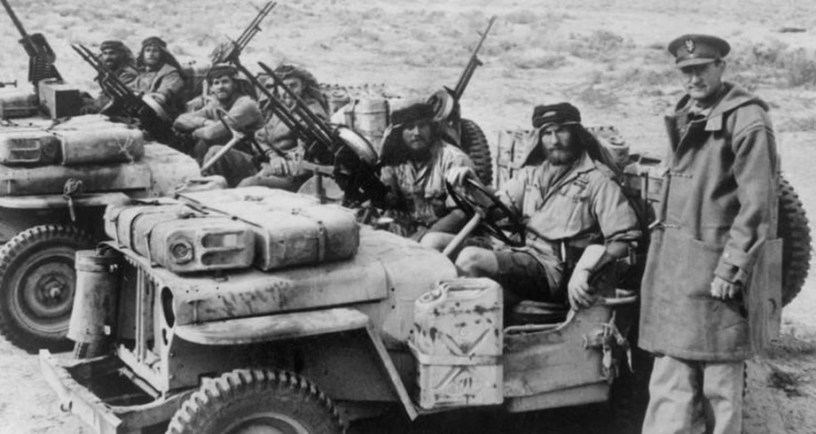
As the war progressed, Stirling realized that relying solely on foot infiltration limited the amount of damage his men could inflict. In 1942, he acquired American Willys Jeeps, which he heavily modified for desert warfare. These vehicles were stripped of all unnecessary weight, fitted with extra water condensers for their radiators, and armed to the teeth with twin Vickers K machine guns taken from obsolete aircraft. These jeeps allowed the SAS to conduct high-speed, mounted assaults directly onto enemy airfields.
The jeep raids were terrifying spectacles of overwhelming firepower. A dozen jeeps would form a line or a V-shape, sweep onto an airfield at maximum speed in the dead of night, and unleash a torrent of tracer ammunition into the parked aircraft, fuel dumps, and barracks. The intense firepower would suppress the garrison defences while the speed of the vehicles allowed the raiders to obliterate the airfield and vanish back into the desert before an effective counter-attack could be organised. A prime example of this tactic occurred at the Sidi Haneish airfield in July 1942, where Stirling’s squadron of jeeps destroyed at least forty aircraft in less than fifteen minutes, completely crippling the local Axis aerial capability.
The impact of Stirling’s campaign extended far beyond the physical destruction of material. He was waging a highly effective campaign of psychological warfare. The German and Italian high commands were forced to divert thousands of front-line troops, vehicles, and anti-aircraft guns away from the battle with the Eighth Army to guard their rear installations. Field Marshal Erwin Rommel, a master of mobile warfare himself, grew increasingly frustrated by these persistent attacks. It was Rommel who famously bestowed upon Stirling the moniker “The Phantom Major,” acknowledging the elusive and disruptive nature of his enemy. The British Prime Minister, Winston Churchill, also took notice of Stirling’s achievements, describing him as “a man of daring and genius” who was single-handedly changing the nature of special operations.
Capture, Captivity, and Incarceration
By late 1942, David Stirling had become a victim of his own success. The Axis forces had grown acutely aware of the threat posed by the SAS and had significantly tightened their security measures around airfields and supply routes. The vast spaces of the desert were becoming increasingly crowded with anti-raiding patrols, radar stations, and air reconnaissance units specifically tasked with hunting down “The Phantom Major.” Stirling’s luck, which had sustained him through dozens of perilous operations, was beginning to run thin. Despite the mounting risks, he continued to lead from the front, refusing to delegate the dangers of operational command to his subordinates.
In January 1943, Stirling embarked on what would be his final operation in the Western Desert. The strategic landscape had changed; the British Eighth Army, now under the command of General Bernard Montgomery, had won a decisive victory at El Alamein and was pursuing Rommel’s forces westwards across Libya towards Tunisia. Stirling’s objective was to infiltrate the mountainous terrain of Tunisia ahead of the advancing British forces, link up with the First Army coming from the west, and disrupt the Axis lines of retreat. It was an exceptionally dangerous mission, requiring the SAS to operate in unfamiliar, restricted terrain that lacked the vast escape routes of the open desert.
The operation went wrong almost from the outset. Stirling’s small group was spotted by local Arab tribesmen who informed the Axis authorities of their presence. German anti-raiding units, led by the capable and relentless Captain Heinz Deutsch, closed in on their position. Stirling and his men sought refuge in a deep wadi near Tunisian territory, hoping to hide during the daylight hours and break out under the cover of darkness. However, the Germans had sealed the exits of the valley. On 24 January 1943, Stirling was ambushed and captured by German paratroopers.
The capture of David Stirling was viewed as a major triumph by the Axis high command, but for Stirling, the war was far from over. He viewed captivity not as a period of retirement, but as a different theatre of operations. He immediately began planning his escape. Within days of his capture, he escaped from his German guards, only to be recaptured by Italian troops shortly afterwards. Over the next few months, Stirling made a total of four escape attempts from various prison camps in Italy. His resourcefulness and physical stature made him a constant nightmare for his captors, who found it near-impossible to contain his restless energy.
Recognising that Stirling was an exceptionally high-risk prisoner, the Axis authorities decided to transfer him to a place where escape was deemed impossible. In September 1943, he was sent to Oflag IV-C at Colditz Castle, a formidable fortress situated on a rocky outcrop in Saxony, Germany. Colditz was specifically designed to house the most troublesome and escape-prone Allied officers. Even within the grim and heavily guarded confines of Colditz, Stirling refused to be subdued. He became a prominent figure in the camp’s escape committee, working alongside other legendary figures to orchestrate complex escape schemes, though his immense height made it difficult for him to personally slip through tunnels or disguises unnoticed. He remained a prisoner at Colditz until the castle was liberated by American forces in April 1945, just weeks before the final surrender of Nazi Germany.
Post-War Legacy and Institutional Evolution
The end of the war did not bring an end to David Stirling’s involvement in global affairs, nor did it diminish his status as a legendary figure in military history. Upon his return to Britain, he found that the SAS, which had grown into a brigade-sized element operating across Europe by the end of the conflict, had been disbanded as part of the post-war demobilisation process. The traditionalists within the War Office were eager to return to conventional army structures, viewing special forces as an expensive wartime luxury that had no place in a peacetime military. Stirling was deeply disappointed by this short-sighted decision, but his concepts had taken root too deeply to be permanently erased.
The geopolitical realities of the Cold War and the rise of anti-colonial insurgencies soon forced the British government to reconsider. In 1947, the unit was resurrected as a Territorial Army unit, the Artists Rifles, which eventually led to the reformation of the regular 22 SAS Regiment during the Malayan Emergency in the early 1950s. The tactics of small-unit infiltration, intensive training, and individual initiative that Stirling had pioneered in the Western Desert became the foundational doctrine of the modern SAS. As the nature of global conflict shifted from conventional warfare to counter-insurgency and counter-terrorism, Stirling’s blueprint proved to be remarkably prescient.
Stirling himself pursued a varied and controversial post-war career. He moved to Africa, where he established the Capricorn Africa Society, an organisation dedicated to promoting a multi-racial, unified vision of African states during the transition away from colonial rule. This initiative demonstrated that Stirling was not merely a destructive force, but a man capable of thinking deeply about political and social structures. Later, in the 1960s and 1970s, he became involved in private military contracting, founding companies like Watchguard International, which provided security training and military assistance to foreign governments, particularly in the Middle East. While these activities drew scrutiny and criticism from some quarters, they reflected his enduring belief in the efficacy of small, professional teams operating outside the constraints of traditional state bureaucracies.
In his later years, Stirling was increasingly recognised as one of the defining figures of twentieth-century warfare. His contribution was not merely the creation of a specific regiment, but the revolution of military doctrine. He had demonstrated that a tiny fraction of a nation’s military resources, if properly selected, trained, and led, could achieve strategic outcomes out of all proportion to its size. His concepts were copied by nations around the world, directly inspiring the creation of elite special forces units globally, from the American Delta Force to the Australian and New Zealand SAS.
David Stirling was knighted in 1990 for his services to the military, a long-overdue official recognition of his extraordinary contributions to the British state. He died later that same year, on 4 November 1990, at the age of seventy-five. Today, his memory is preserved not only in the traditions of the regiment he founded but also by a striking bronze statue that stands on the Hill of Row, near his ancestral home in Perthshire. The monument depicts Stirling as he was during the desert campaign: a towering figure wrapped in a duffle coat, gazing out over the rugged Scottish landscape, looking eternally toward the horizon.
Conclusion
The legacy of Lieutenant-Colonel Sir David Stirling is defined by an uncompromising refusal to accept the limitations imposed by tradition and bureaucracy. In an era dominated by industrial-scale armies and massive clashes of armour, he had the vision to see that individual courage, intelligence, and adaptability still held a decisive place on the modern battlefield. He took the traditional Scottish martial virtues—fierce independence, physical resilience, and a love of freedom—and forged them into a modern, lethal instrument of strategic warfare.
Stirling’s life is a testament to the power of a disruptive idea. When faced with catastrophic failure after his initial operation, he did not abandon his vision; instead, he refined it, turning adversity into the foundation of his greatest successes. He understood that the essence of special operations was not reckless bravado, but calculated risk, meticulous planning, and absolute precision. The Special Air Service remains his living monument, an institution that continues to operate on the principles he laid down in a hospital bed in Alexandria over eighty-five years ago. David Stirling did not just win battles; he altered the grammar of conflict, ensuring that “The Phantom Major” would forever occupy a pre-eminent position in the annals of military history.
 Fellowship & Fairydust