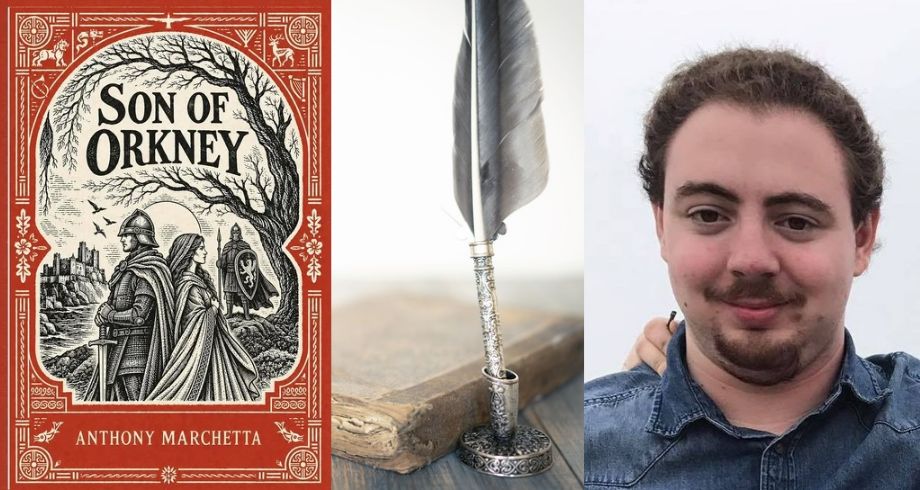
BY ANTHONY MARCHETTA
King Arthur is in the news cycle right now. With the Pendragon Cycle one of the most popular shows in the world – deservedly so, by the way – and Malcolm Guite’s utterly remarkable masterpiece, Galahad and the Grail, making the rounds, now is a great time to be breaking intoArthuriana. As the author of two forthcoming Arthurian novels (and editor and co-writer of a now out-of-print King Arthur anthology), I feel I have earned the right to speak a little bit about the subject.
So here are my thoughts.
First: The easy thing to do would be to say, “Nothing! You just have to WANT to write Arthuriana!”
Nope. I don’t believe that. I am pro-gatekeeping. Bar those gates and hold them shut, baby.
Okay, that’s a little harsh. Look, I can’t stop you from writing what you want, nor do I want to. So let me make a more modest claim:
If you want to contribute something good and interesting to Arthuriana, a certain baseline of knowledge is necessary.
So what is that baseline? The Arthurian well goes very, very deep. Luckily, however, I think there’s a very simple answer:
If you want to write Arthuriana, you need to read Le Morte d’Arthur.
If you’re angry about this, consider, by analogy, someone saying, “I want to write a novel about the fall of man! You know, the snake and Adam and Eve and stuff.”
“Great!” you say. “What do you think of the first chapters of Genesis, then?”
But our budding author rolls his eyes. “You gatekeeper! I don’t need to read Genesis! I looked it all up on Wikipedia. I know the story.”
Sounds pretty silly, right?
Or someone saying they wanted to write a Sherlock Holmes pastiche, then confessed they had never read, and had no interest in reading, Conan Doyle’s 60-story canon. Surely it would be uncontroversial to say that if you wanted to be a professional Sherlockian pastiche writer – and this has become an extraordinarily popular subgenre -, the bare minimum to read would be Conan Doyle’s canon, right?
And, to my own shame, I know what sort of problems writing without the proper baseline of knowledge causes from experience. I edited and co-wrote an Arthurian anthology before I had ever actually read Malory. I had read Lawhead’s Pendragon Cycle and The Once and Future King, and I knew Arthuriana well enough to think I knew what I was doing. I didn’t.
In fact, the first draft of my own After Camelot was written before I read Le Morte d’Arthur. I read Malory afterward and then heavily revised the novel in light of what I had learned. The resulting book is, in my opinion, much better for it.
So I’m not telling you to do something I did naturally from the beginning. I’m telling you not to make the mistake I made.
Right. Onward. Now, why do I say you need Le Morte specifically?
The Arthurian well is vast and deep. It has branches, sub-branches, sub-sub-branches. A possible early reference to Arthur appears in Y Gododdin, a Welsh heroic poem whose material may date to around the year 600; around 1100, Culhwch and Olwen – later collected among the tales we call The Mabinogion – gives us a very weird and very Welsh Arthurian world; and the first great foundation of the medieval literary Arthur comes from Geoffrey of Monmouth’s History of the Kings of Britain around 1136. Fast forward to the 1170s and 1180s, and you get the hugely influential Chrétien de Troyes, who gives Lancelot his first great starring role and introduces the Grail into surviving Arthurian literature.
Malory does not write until about 1470 – over 300 years after Geoffrey of Monmouth. So why is Malory the must-read guy, and not Chrétien, Geoffrey, or the Mabinogion?
To understand this, one must understand what Le Morte d’Arthur actually is. It is a single sustained narrative, at least in my opinion. This is a matter of scholarly dispute, but there is significant narrative continuity. Malory is sometimes criticized or mocked for loose continuity, but sometimes it’s so tight as to be remarkable: in Book VII, The Tale of Sir Gareth of Orkney, Gareth criticizes Sir Gawaine for being vengeful; this is a character flaw that pays off in Book XX, hundreds and hundreds of pages later – and it is clearly intentional, since the act that triggers Gawaine to seek vengeance is the very death of Gareth himself. That is beautifully executed foreshadowing.
But calling Le Morte *only* a single sustained narrative is also misleading, and misunderstands Malory’s real goal. At this point in history – we’re in the late Middle Ages now – there had been hundreds of years’ worth of Arthuriana accumulated, from many different sources, ranging from Britain to France to Germany. Malory’s goal was as simple as it was ambitious: He was going to cram as much of it as he possibly could into one chronological story.
Frankly, the fact that it has as few continuity errors as it does is much more interesting than the fact that it has continuity errors.
It gives you the birth of Arthur, the sword in the stone, Merlin, Morgan le Fey, the Orkney brothers, the Grail Quest, Balin le Savage, Tristan and Isolde, Lancelot and Guinevere, the fall of Camelot, and Avalon, all in one sustained story. It is our only surviving major source, and possibly the originator, of Sir Gareth’s story, and in many ways it has become the de facto canonical version of things like the Grail Quest. If you read Le Morte, you get a crash course on everything Arthurian.
Now, I want to be clear: I think Le Morte is the minimum. If you want to write a King Arthur that is more Welsh – like Lawhead’s excellent Pendragon Cycle – then you need to read some of the Welsh sources. If you want to venture outside of the Malorian tradition, you’ll need to read outside of the Malorian sources. But even if you decide to do that, you have to read Malory. Everything Arthurian orbits around Malory; he is a black hole that pulls the rest of Arthuriana around him by sheer gravitational weight.
Take Lawhead. Lawhead wrote an intentionally non-Malorian Arthuriad. But he very, very obviously was familiar with Le Morte. Just read his novel Grail; it was an original retelling of the Grail quest, but it was obviously riffing off of Malory. Sure, it was intentionally deviating from Malory in most ways, but even those deviations were clearly in response to Malory. In my own work, I am of course not slavishly faithful to Malory; otherwise, you would just read Malory. But my books are a gloss on and, in some limited and delicate ways, a response to Malory. Not a subversion or deconstruction, but nevertheless, I do make some intentional and deliberate changes.
If I did not read Malory, I would have less interesting and insightful things to say. I would be commenting on a tradition that I did not understand – the very height of arrogance.
You could read more. You probably should. But if you want to write Arthuriana – read Malory.
A word of caution: Le Morte d’Arthur is a very difficult book to read. It’s good! But difficult. There’s no getting around this, I’m afraid. My recommendation is Gerald J. Davis’s Le Morte d’Arthur: The New Retelling. Do not let the word retelling scare you off. Davis stays very close to Malory while rendering the language substantially more accessible, working from the two principal surviving textual witnesses, the Winchester manuscript and Caxton’s printed text of Le Morte d’Arthur. It is not a substitute for a scholarly edition, but if your purpose is to absorb Malory’s enormous Arthurian narrative rather than conduct textual scholarship, I found it a very great boon. Remember, we’re authors, not medieval scholars. Our goal is to grasp Malory’s story, not gain an authentic medieval register. The new retelling gets you to the finish line quite ably in that respect.
This article was previously published on September 19, 2026 on The Mechanical Dragon Substack and September 20 on The Mechanical Dragon WordPress.
[mc4wp_form id="5878"]