
BY KAREN ULLO
A few years ago, I was having lunch with my uncle when he said he had joined the Sons of the American Revolution. “But in the 1770s, our ancestors were already in Louisiana,” I said. “It belonged to Spain. How did we have an ancestor who fought for America?”
It turns out, we didn’t. We had an ancestor—a French immigrant to Louisiana—who fought for Spain. From 1779-1781, Spain aided the American cause by ousting the British from their holdings in West Florida, which included Pensacola and Mobile as well as the eastern bank of the Mississippi River from Manchac to Natchez. The name of the colony still resonates today in the “Florida Parishes,” the eight parishes of the State of Louisiana that were once part of West Florida.
After the outbreak of the American Revolution in 1775, the fledgling United States campaigned to secure the support of European allies, especially Britain’s longtime enemies, France and Spain. Though the King of Spain was unwilling to form an alliance, the Spanish governor of Louisiana, Bernardo de Galvez, privately supported the American cause. He granted loans to American traders shipping military provisions northward from New Orleans and provided covert support to their convoys, which had to pass the British-held settlements on the eastern bank in order to reach American territory.
In 1777, the U.S. Congress rejected a plan to launch a full-scale assault against West Florida. But the Committee of Commerce (formerly the Secret Committee, the first American organization devoted to espionage) knew they had the tacit support of Governor Galvez in New Orleans. So they decided to send a small party of men down the Mississippi under the command of Captain James Willing, ostensibly to convey “public dispatches” to officials in Louisiana.
His real mission was to secure the river.
Captain Willing and the crew of the U.S.S. Rattletrap began their journey down the Ohio River in January of 1778, picking up additional boats and recruits along their route. British officials received intelligence about the mission but did little to prepare. They expected Willing’s crew to be delayed by ice. Instead, Willing arrived at Natchez in February, where his crew hoisted the American colors over the poorly-manned British Fort Panmure, ransacked the homes of Loyalist planters, and elicited a pledge from the citizens “not in any wise [to] take up arms against the United States of America.”
Fortified with additional recruits from Natchez, Willing continued his journey. Between British Point Coupée and Manchac, his party pillaged every settlement, slaughtering livestock, seizing slaves, and collecting the spoils of war. Though they sometimes distinguished the property of American sympathizers from that of British Loyalists, other reports detailed thievery even against settlers who had taken oaths of neutrality.
Knowing that Willing was on his way to New Orleans, the crafty Governor Galvez issued an edict offering “protection to both sides should they flee to the city of New Orleans,” thereby maintaining Spanish neutrality while ensuring he would have no need to surrender Willing to the British. Galvez required Willing to return any property seized on the river south of Manchac, where Spain controlled both banks, while permitting him to auction off $62,500 worth of plunder from British settlements further north. Willing had effectively conquered the Mississippi River for the United States without causing a single death.
But American control of the river was short-lived. Willing had no resources to stage an occupation, and British officials in Pensacola dispatched soldiers to retake the territory. By May of 1778, British control of Natchez was strong enough to prevent American ships from using the river to send supplies to the Atlantic colonies.
Meanwhile, on the world stage, as France began openly supplying arms, ammunitions, and troops to the United States, British suspicion of Spain redoubled. France and Spain were united by longtime military alliances, the Bourbon dynasty that had birthed both their kings, and their shared Catholic religion. It was difficult to imagine that Spain would not join France’s cause.
Galvez knew that war was imminent and began collecting intelligence about British forces to plan his own campaigns. Britain likewise sent 1200 troops to reinforce West Florida. They arrived in Pensacola in January of 1779, and then began the trek to reestablish military control of both Manchac and Baton Rouge.
On June 21, 1779, Spain declared war on Great Britain. Galvez received the news in early August and lost no time putting his own plans into motion. On August 20, 1779, he assembled the people of New Orleans in front of the Cabildo (an earlier structure than the one that now stands) and announced his fears that Britain planned to invade New Orleans—but he would take the battle to the enemy before they could destroy the city. To the beat of drums, Galvez and the people pledged their lives to the defense of Louisiana, and Galvez publicly proclaimed the independence of the United States of America.
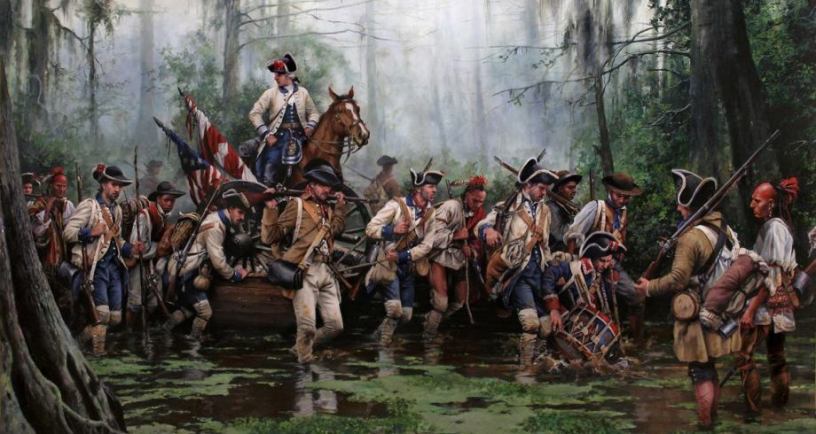
He then assembled a militia reflective of the people he governed: Spanish regulars augmented by Acadians, Germans, free Blacks, and Native Americans, along with seven American volunteers and the American merchant Oliver Pollock, who served as the governor’s personal aide de camp. With this force, Galvez began his march to take the eastern bank of the river.
The refortification of Manchac had proceeded poorly, and when the British received word of Galvez’s advance, they sent a majority of their forces north to hurry the fortification of Baton Rouge. On September 7, Galvez captured Manchac in a skirmish that killed only one British soldier and none of his own men. He gave the victors six days to rest, then proceeded on his campaign.
At Baton Rouge, the British had established an earthen fort surrounded by a dry ditch eighteen feet wide and nine feet deep. Inside this moat was “a circle of palisades in the form of Cabellas de Frisa”—a “frizzy” arrangement of deadly, pointed stakes. The fortification housed thirteen cannons and an estimated 550 men, including 400 British regulars.
Galvez arrived at Baton Rouge with only 200 men. An assault of the kind he had staged at Manchac would have been suicide. His only advantages were artillery of a higher caliber than that of the British—and the fact that he was Bernardo de Galvez. On September 20, after dark, Galvez dispatched a small number of his Black and Native American troops to stage a diversion in a grove of trees. Some men chopped down the grove, appearing to build fortifications, while others fired at the fort as if in defense of the project. The grove was out of range of British cannon, but the British fell for the ruse. They turned their arms and fired. While the British cannons were facing the grove, Galvez moved his own artillery into position on the other side of the fort and bombarded the embankment.
At 3:30 that afternoon, Lieutenant Colonel Alexander Dickson sent a delegation to ask for terms of surrender. Spain lost only one man in the battle. British losses numbered about twenty-five.
But Galvez had yet another surprise in store. Knowing that he did not have the forces necessary to capture the much better-defended Fort Panmure at Natchez, he refused to accept the surrender of Baton Rouge unless Dickson ceded Natchez too. Dickson had no choice but to concede or let his men be slaughtered. When the papers were signed, Galvez dispatched an officer and fifty men to accept the surrender of Fort Panmure while he returned to his post in New Orleans.
In 1780, Galvez went on to launch a successful naval assault against Mobile, but a hurricane disrupted his plans to attack Pensacola. That feat was finally accomplished on May 8, 1781. Britain formally ceded West Florida to Spain in the Peace of Paris in 1783.
Although Spain never declared a formal alliance with the United States—and indeed, the Spanish monarchy maintained a healthy fear of “republicanism”—Galvez’s campaign secured the Mississippi River so that American shipping, both commercial and military, could flow without British interference. In addition to Galvez’s covert loans, Spain also provided direct monetary assistance to the United States that helped finance General Washington’s siege of Yorktown. In gratitude for Spain’s contributions to the cause of independence, Galvez’s soldiers—including my own ancestor, Antoine Bellard—are now recognized as heroes of the American Revolution.

