
BY AMANDA PIZZOLATTO
1776
With the 250th anniversary of America, it seemed only right to check out movies pertaining to American history that I had never seen before. One of those was 1776, a musical about the month leading up to Congress signing the Declaration of Independence. Of course, they had to take some liberties. I very highly doubt John Adams was singing his letters to his wife and that she could hear them all the way in Massachusetts, but even with said liberties, it comes out as a rather fun movie about the men who put together and signed the Declaration.
The movie basically follows John Adams as he constantly tries to get Congress to vote on independence from Britain. Benjamin Franklin of course is shown to be his main, and biggest, ally. Together, they work to move Congress’s opinion to their side. Plenty of memorable songs throughout, moving the plot forward as well as providing context in song format. Despite quite a few being fun songs, like “The Lees of Old Virginia” and “He Plays the Violin,” and are sure to be stuck in your brain, others provide more gravity to their situation. The big one that really turns things from being fun to needing tissue is “Momma Look Sharp,” giving us some insight into the lives of the men on the battlefront, far from the cushy debates of Congress. The turning point to the whole movie seems to be then as well as we get more serious in the second half, as we get closer to July 4th. Which makes sense considering the phenomenal decision Congress was going to make concerning the thirteen states going forward. The movie ends with the actors replicating the famous painting of the signing of the Declaration of Independence.
William Daniels leads this motley Congress crew as John Adams, though many might remember him better now as Mr. Feeney from Boy Meets World. He, along with the vast majority of the cast, had played these characters on Broadway for a few years before they began shooting this film. Ken Howard, Ron Holgate, and Howard da Silva are among the cast who joined him from the Broadway side. Some of the Congress members did not come from Broadway, like Donald Madden as John Dickinson and John Cullum as Edward Rutledge, but were very well trained vocally and it shows in their musical numbers.
There are some instances of references to relations between husbands and wives, talked about mainly by said husbands and wives. Nothing explicit, but it is referenced. One song was actually cut by request by the President of the time, Richard Nixon, as it does make more of a reference to politics of the 1970s rather than the 1770s. But then, a lot of the verbiage used was more from the 1970s rather than the 1770s, so, there is that too. Which brings me to the worst possible issue with the whole thing, the historical inaccuracy of it all. A lot of the members of Congress and events were changed for, well, a play, for entertainment. While the movie shows half of Congress dragging their feet on the issue of independence, Congress in reality had already decided to become independent by the date the movie opens on. The vote for it didn’t happen until the 2nd, and the signing on the 4th, true, but they didn’t need to be argued with to get independence. But as with all historical fiction, sometimes it’s just fun, and this is no different.
All in all, it is well made and quite the ride from beginning to end. If you’re into musicals and American history, I highly recommend this. I would recommend it to anyone willing to give it a chance, to be honest. It’s available to watch on YouTube and Tubi with ads. You know, I wasn’t sure if I would like it myself, but I ended up thoroughly enjoying it and have watched it multiple times since my first watch. By the end I hope you will enjoy it as well, and be glad that John didn’t sit down, definite-lee.*
*Referencing a song, which can be watched by itself on YouTube if you want just that reference, “The Lees of Old Virginia.”
Yankee Doodle Dandy
The Congressional Gold Medal is a pretty high mark of recognition of the U.S. Congress for a person’s achievements. For decades it was normally handed to men in the military, in science, and in exploration. But in 1940, it was handed to a different kind of man, the first of his kind to receive this honor, a musician and playwright by the name of George M. Cohan.
George Cohan was said to come into this world already waving the American flag as he was born on the Fourth of July. According to his birth certificate from St. Joseph’s Roman Catholic Church, it was actually the day before, but his parents apparently celebrated it on the fourth of July, and it has been associated with him ever since. It’s even stated as being his birthday in the 1942 movie about his life, Yankee Doodle Dandy. In it, it shows his father running through a Fourth of July parade to get home to find his newborn son waiting for him. His parents decided to name him George after George Washington because of it. They decided against the Washington part because they were vaudeville actors and thought it wouldn’t look good on a vaudeville sign. When George, and his sister Josie, were old enough, they learned how to sing and dance and joined their parents on stage. This created a long-standing career of the “Four Cohans,” which became quite popular at the time.
But eventually George wanted to break away, as he was not only talented on the stage, he was also talented off stage. He not only wanted to act and sing, he also wanted to write. He eventually wrote many plays and songs that became hits on Broadway, some of which even starred his family. But his crowning achievements, which earned him the Congressional Gold Medal, were the songs “You’re a Grand Old Flag” and “Over There,” the latter of which became the American anthem during World War I. That song was still in wide use by the time World War II came around, which probably also ignited the idea to do the movie, Yankee Doodle Dandy. Well, more like earning the Congressional Gold Medal started that ball rolling, but the war probably hurried it along.
James Cagney has the leading role, playing George in such a way that even impressed George himself. He was, thankfully, able to see it as the movie came out in May of 1942. In November of 1942, George M. Cohan passed away, almost a year after the United States entered World War II.
The movie itself focuses mostly on Cohan’s career, starting with his family’s theater run as the “Four Cohans,” and ending with his portrayal of President Franklin D. Roosevelt at the behest of his friend and partner in business, Sam H. Harris. As such, it also focuses on his relationships with them, along with his relationship with his wife Mary, though their kids are never brought into the picture. His most popular songs and plays are also showcased in the movie, giving us a glimpse of the man’s genius. Though it wasn’t mentioned in the movie, several of his plays were turned into movies, some of which he starred in. Many have been adapted several times over the years, one of which even starred Vincent Price, based on his play Seven Keys to Baldpate.
That being said, much of his life’s work, besides those few songs and plays, are now mostly lost to time and memory. Oscar Hammerstein, of Rodgers and Hammerstein fame, requested a statue of Cohan to be raised in New York Times Square, where it has stood since 1959. He has a star in the Hollywood Walk of Fame, he was inducted into both the Songwriters Hall of Fame and the Long Island Music Hall of Fame, there was a commemorative stamp issued in 1979, and there is an annual award named in his honor. But beyond that, and perhaps the few songs the public might still know, what else is remembered about the man himself? How many people have even seen the movie Yankee Doodle Dandy?
While it is still available on DVD, the options for streaming are limited. Well, to be frank, basically nonexistent. Google still claims it’s available to purchase for streaming on Amazon and AppleTV, but it’s no longer available. (Google, get your act together, man. George Cohan wrote 50 and did even more than that.) I went and purchased the DVD just so I could watch it for the first time ever. Definitely worth it, if even to just hear some of the songs that were popular at the time of World War I or to watch it as part of the AFI’s list of 100 Years – 100 American Movies. Again, it is a dramatized, or well, more like Hollywood, version, naturally, but it is still a good story about an American entertainer who basically inspired the likes of Rodgers and Hammerstein, and I’m sure you’ve seen at least one of their movies.
Now comes the question, what song will you be humming after it’s over? Were there any songs you, in fact, recognized, just you didn’t know he wrote it? I know I have never heard of any, but the songs are so memorable that, once you’ve finished, you’ll feel like you’ve known them your whole life. So go on, link arms with this Yankee Doodle Dandy and let him dance you across the stage and into the play that was his life.
Mr. Smith Goes to Washington
Before Frank Capra could open “The Greatest Gift,” he would journey with “The Man from Montana.” Before staying in Bedford Falls, there was a trip to Washington D.C. Before there was George Bailey, there was Jefferson Smith.
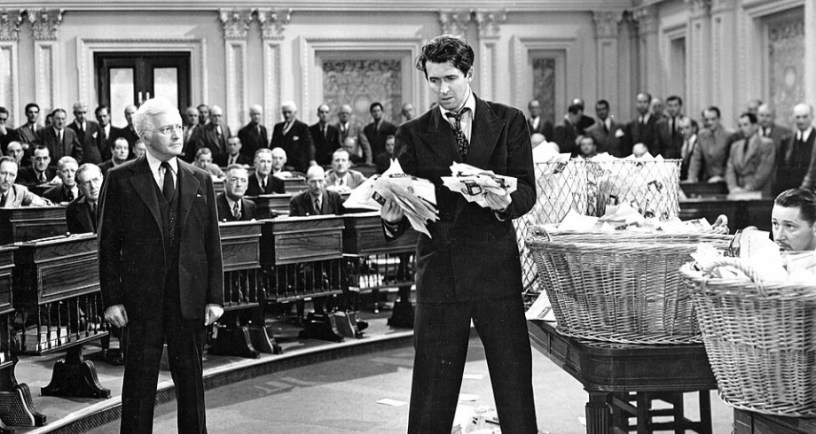
Jefferson Smith is the titular character in Frank Capra’s feature film Mr. Smith Goes to Washington (1939), played to perfection by Jimmy Stewart. Jefferson, or Jeff, starts out being the head of a Boy Rangers group, but is recommended as the next Senator by the sons of the Governor of some unnamed western state. The Governor eventually gives in and Jeff is appointed as the newest Senator. Upon arriving in Washington, Jeff proceeds to do some sightseeing before reporting to his office. His secretary, Clarissa Saunders, doesn’t know it’s him at first, she gets him up to speed on what he needs to be doing right at that moment in the Senate. And well, his entire run as a Senator. However, it isn’t long before the newspapers start making fun of him. Being a man of action, well, he goes into action and starts punching some of them. He soon comes to understand more about why they said what they said and starts really considering what being a Senator actually means. For him, he wants to put together a boys camp for the Boy Rangers. But as he progresses with Saunders tutoring, things start to unravel in such a way that his integrity and that of the Senate is called into question. But it’s Jimmy Stewart playing Jeff, so it goes to reason that things would turn out well in the end.
That being said, there are some allusions to things and practices that many an American citizen complains about today that seemed impossible, unthinkable, even scandalous to even consider back when this movie came out. So much so that many people considered putting in a new law to prevent this kind of movie being made ever again. But that could be said to be part of the reason why it needed to be made, for such a time as this. Not that corruption couldn’t have found its way into the Senate back then, it’s just more known now, and a little too common.
That being said, all in all, this was an enjoyable look into the Senate at the time and the psyche of an honest man wanting to do good by his hometown. That man then takes a stand for what he believes in, and that provides the major turning point of the story, especially as his opponent seems to hit him from every side. This was the ideal Senator, well, basically still is, as many people would naturally rally around an honest man. But the hurdles he has to overcome sound so common today that one would watch it and long for Mr. Smith to head to Washington and shake things up again.

